Use this as a quick reference for vector resolution and projectile motion.
🧭 Plot Summary
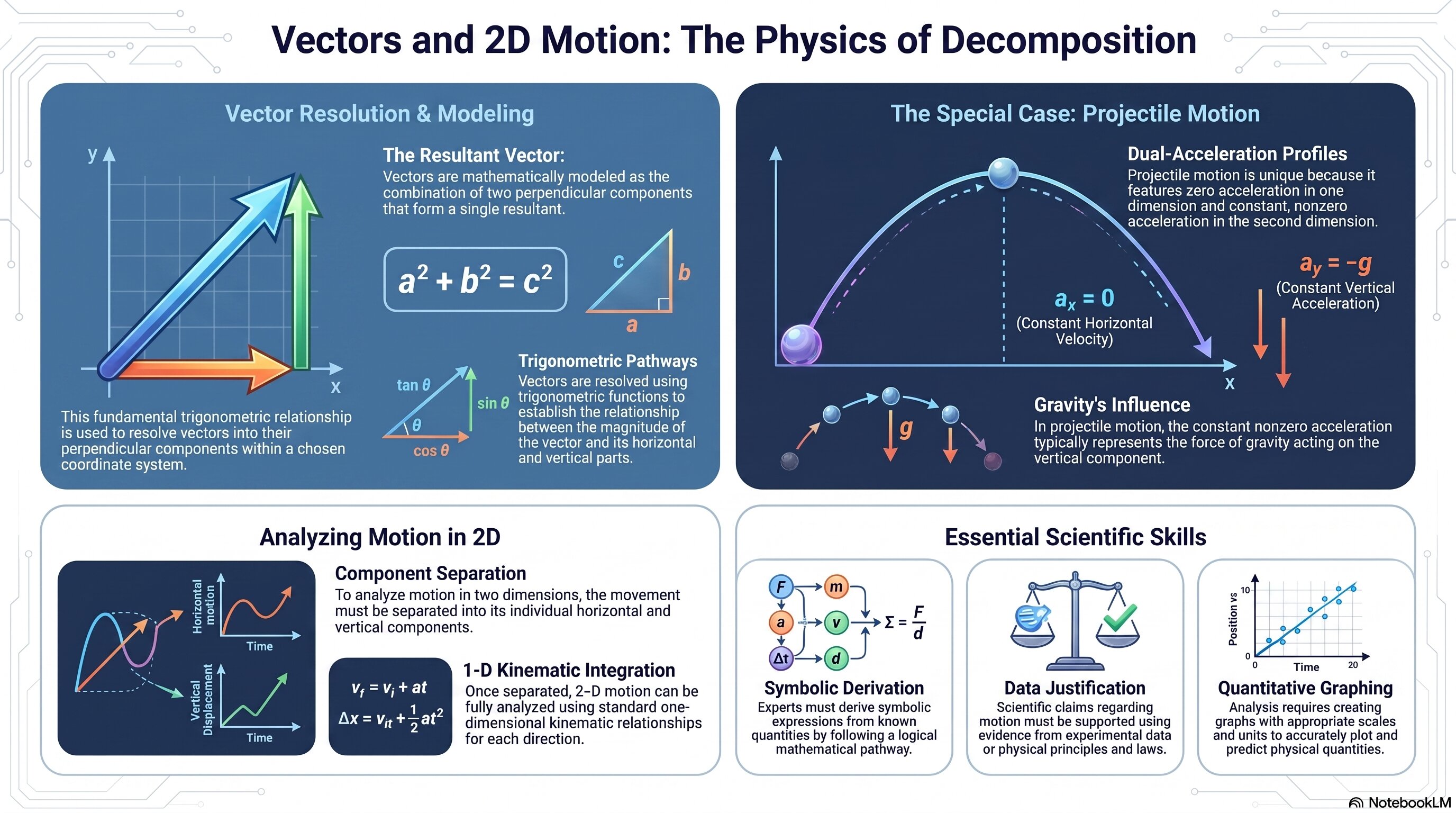
Everything in this lesson rests on one trick: any motion that happens in two dimensions can be split into two separate one-dimensional problems that don't interfere with each other. A vector at an angle becomes a horizontal piece and a vertical piece. A thrown ball becomes a horizontal motion problem (constant velocity) plus a vertical motion problem (constant acceleration from gravity) — solved completely independently, then combined back together.
Vector resolution toolkit
What you'll do in this lesson
- Model any vector as the resultant of two perpendicular components.
- Choose a coordinate system and resolve vectors into x and y components.
- Use sin θ, cos θ, and tan θ to calculate vector components from magnitude and angle.
- Analyze 2D motion by separating it into two independent 1D problems.
- Identify projectile motion as zero acceleration in one direction and constant acceleration in the other.
- Apply 1D kinematic equations independently to horizontal and vertical motion.
Why it matters
This is the season finale of Unit 1 — and the bridge into everything that follows. Projectile motion shows up constantly for the rest of the course. The trick of separating horizontal and vertical motion is one of the most reused ideas in all of AP Physics 1.
✅ Self-Check Before You Roll On
Check off each item as you get there. These aren't grades — they're your own signal.