Use this as a quick reference for physical pendulums, the restoring-torque derivation, the simple pendulum as a special case, and torsion pendulums.
🧭 Plot Summary
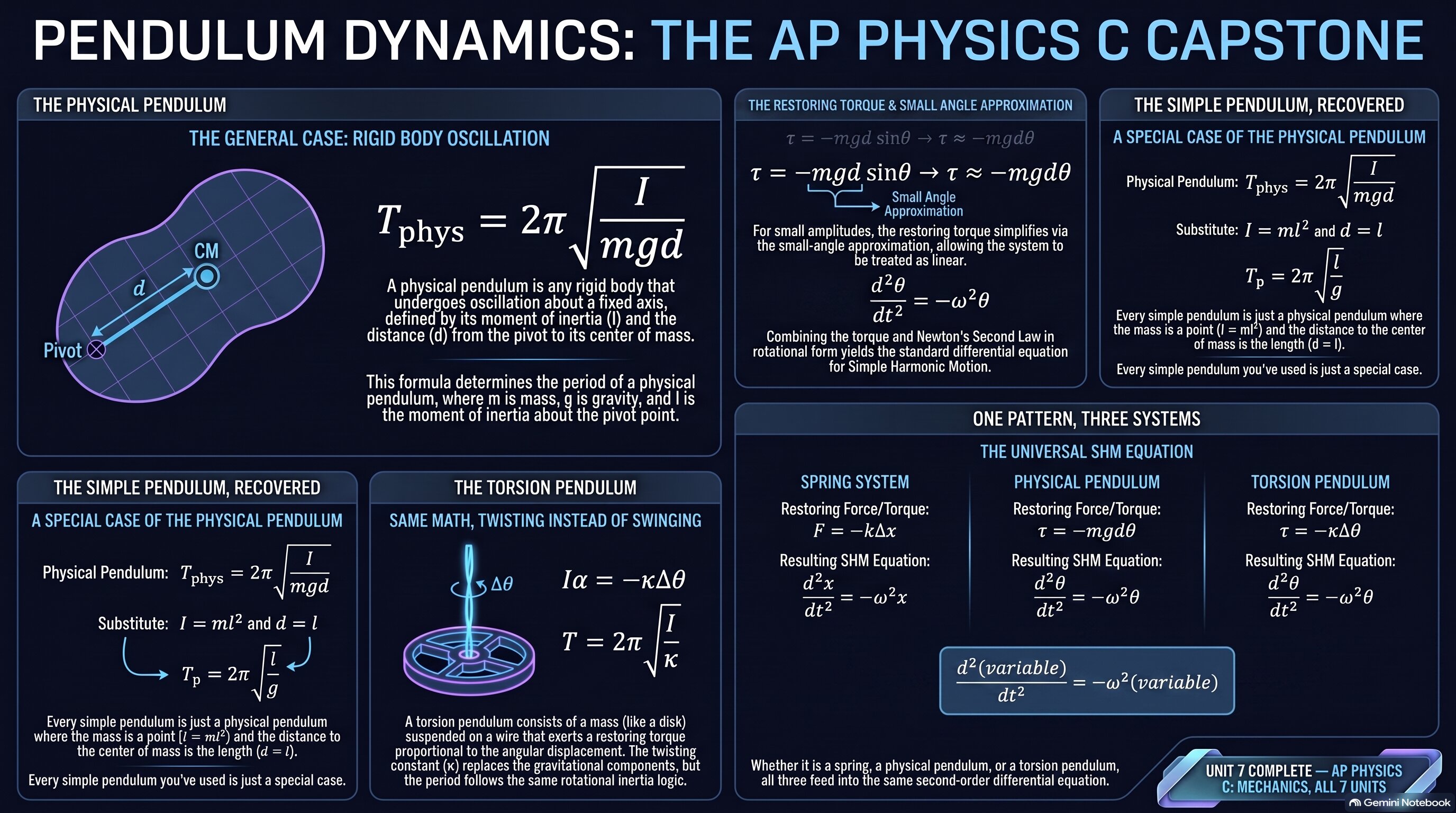
This final lesson generalizes everything you know about pendulums. A physical pendulum is any rigid body that swings about a fixed axis — not just a point mass on a string — and its period is Tphys = 2π√(I/mgd), built from rotational inertia I and the distance d from the pivot to the center of mass. Displace it, and gravity acting at the center of mass creates a restoring torque τ = −mgd sinθ; for small angles, sinθ ≈ θ, and that torque produces the exact same SHM differential equation you saw back in Lesson 7.3. The simple pendulum from Lesson 7.2 turns out to be nothing more than a physical pendulum where all the mass sits at one point — plug that in, and Tp = 2π√(l/g) falls right out. And a torsion pendulum, twisting instead of swinging, obeys the same SHM pattern with a restoring torque proportional to angular displacement instead of gravity.
What you'll do in this lesson
- Describe a physical pendulum and find its period with Tphys = 2π√(I/(mgd)).
- Derive the restoring torque τ = −mgd sinθ, and apply the small-angle approximation sinθ ≈ θ.
- Connect the small-angle restoring torque to the SHM differential equation d²θ/dt² = −ω²θ.
- Derive Tp = 2π√(l/g) as the simple-pendulum special case of the physical pendulum formula.
- Describe a torsion pendulum and find its period from Iα = −κΔθ.
Why it matters
This lesson is the payoff for the whole unit: every restoring force, every differential equation, every period formula you've learned all turn out to be the same idea, wearing different costumes.
✅ Self-Check Before the Final Swing
Check off each item as you get there. These aren't grades — they're your own signal.