Use this as a quick reference for the x(t)/v(t)/a(t) graphs, the SHM differential equation, and resonance.
🧭 Plot Summary
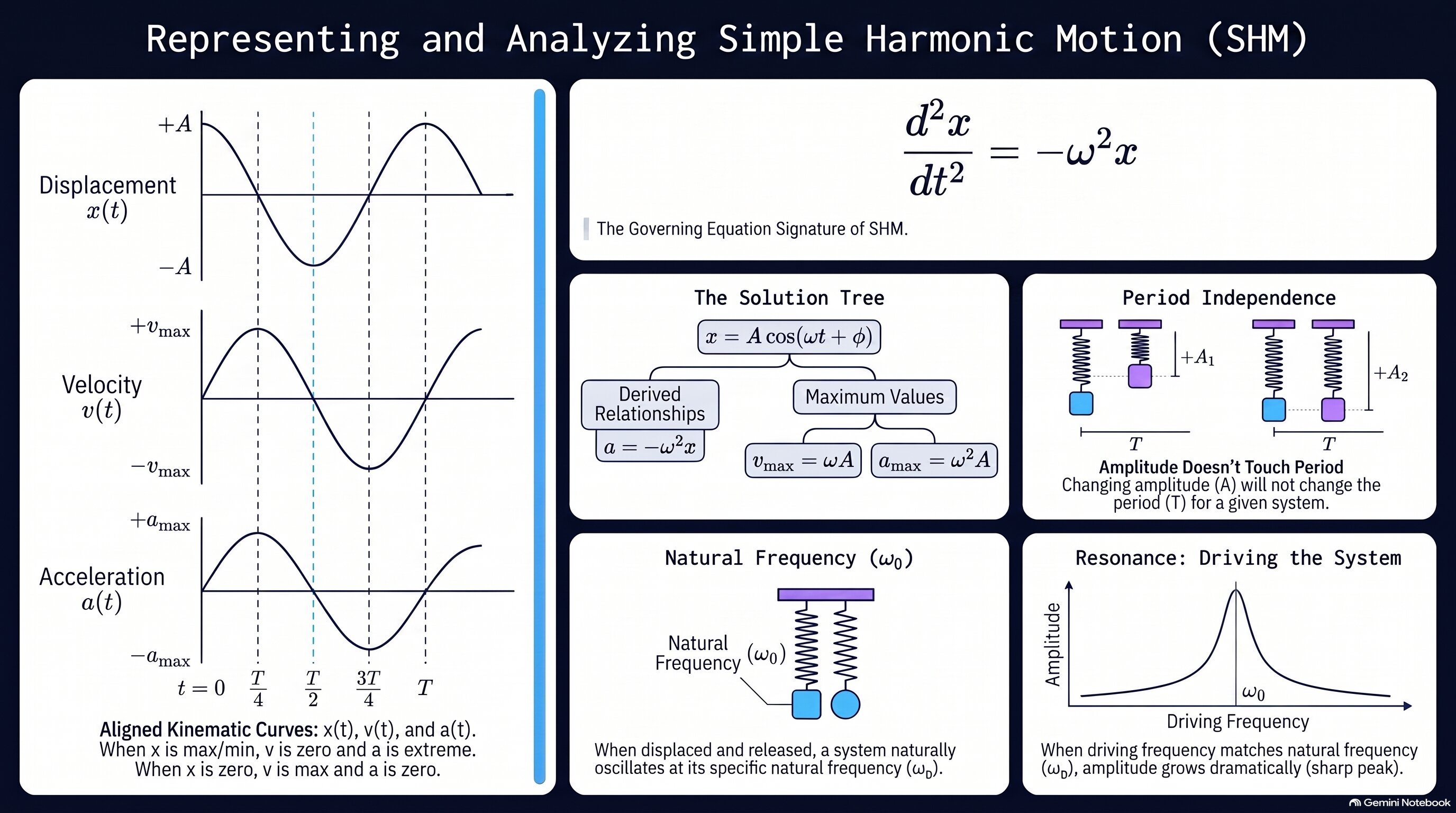
This lesson gives SHM its full mathematical toolkit. Position, velocity, and acceleration all trace out sinusoidal curves — x = A cos(ωt + φ) — and once you know one of them, the other two follow directly: velocity is greatest exactly when displacement is zero, and acceleration is greatest exactly when displacement is at its extremes, following a = −ω²x. That equation isn't a coincidence — it's the solution to the same second-order differential equation, d²x/dt² = −ω²x, that defines SHM in the first place. And when an external force drives a system at its own natural frequency, something dramatic happens: resonance, where amplitude grows dramatically larger than usual.
What you'll do in this lesson
- Represent SHM position with x = A cos(ωt + φ), and identify amplitude, angular frequency, and phase.
- Locate the extrema and zeros of displacement, velocity, and acceleration graphs for SHM.
- Recognize x(t) as the solution to d²x/dt² = −ω²x, and use a = −ω²x directly.
- Compute maximum velocity and acceleration with vmax = ωA and amax = ω²A.
- Explain resonance — what it is, when it happens, and what it does to amplitude.
Why it matters
This lesson is the AP exam's favorite place to test "Translation Between Representations" — moving fluently between graphs, equations, and verbal descriptions of the exact same SHM system.
✅ Self-Check Before You Resonate
Check off each item as you get there. These aren't grades — they're your own signal.