Use this as a quick reference for the period–frequency relationship and the period equations for spring and pendulum systems.
🧭 Plot Summary
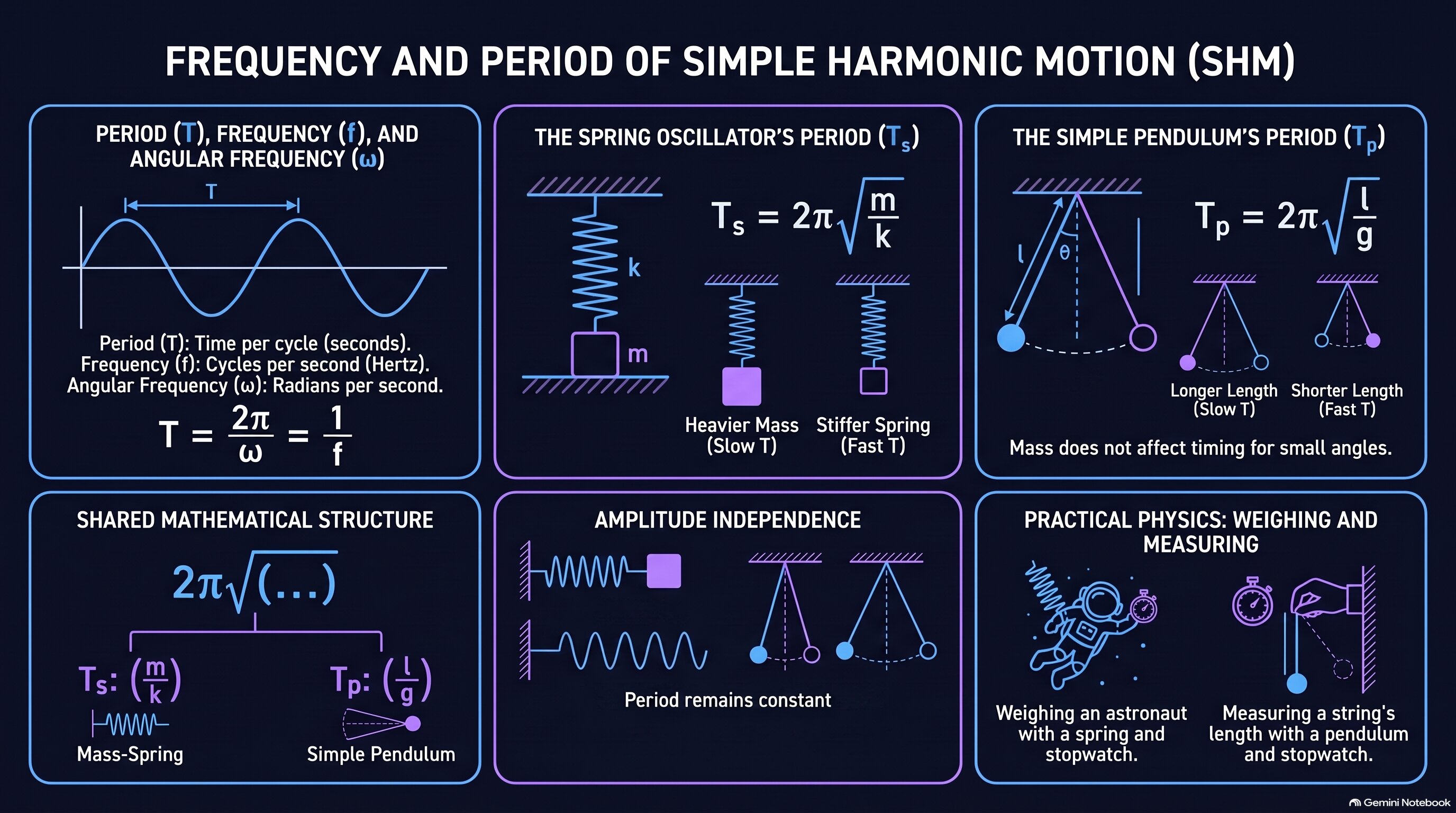
Now that you can recognize SHM, this lesson puts a clock on it. Every SHM system has a period — the time for one full cycle — and a frequency, how many cycles happen per second. They're tied together, and to the system's angular frequency ω, by T = 2π/ω = 1/f. What makes this lesson powerful is that two of the most common SHM systems have their own ready-made period formulas: a mass on an ideal spring oscillates with Ts = 2π√(m/k), and a simple pendulum at small angle oscillates with Tp = 2π√(l/g) — neither one depending on amplitude at all.
What you'll do in this lesson
- Relate period, frequency, and angular frequency: T = 2π/ω = 1/f.
- Find the period of a mass–ideal-spring oscillator: Ts = 2π√(m/k).
- Find the period of a simple pendulum at small angle: Tp = 2π√(l/g).
- Predict how period changes when mass, spring constant, or pendulum length is scaled.
- Use measured periods to solve for unknown quantities like mass or length.
Why it matters
These two period formulas are some of the most-used equations on the AP exam — and they show up in surprising places, from weighing an astronaut in zero gravity to measuring the length of a string with nothing but a stopwatch.
✅ Self-Check Before You Cycle On
Check off each item as you get there. These aren't grades — they're your own signal.