Use this as a quick reference for periodic motion, the restoring-force condition, and how to tell SHM apart from other periodic motion.
🧭 Plot Summary
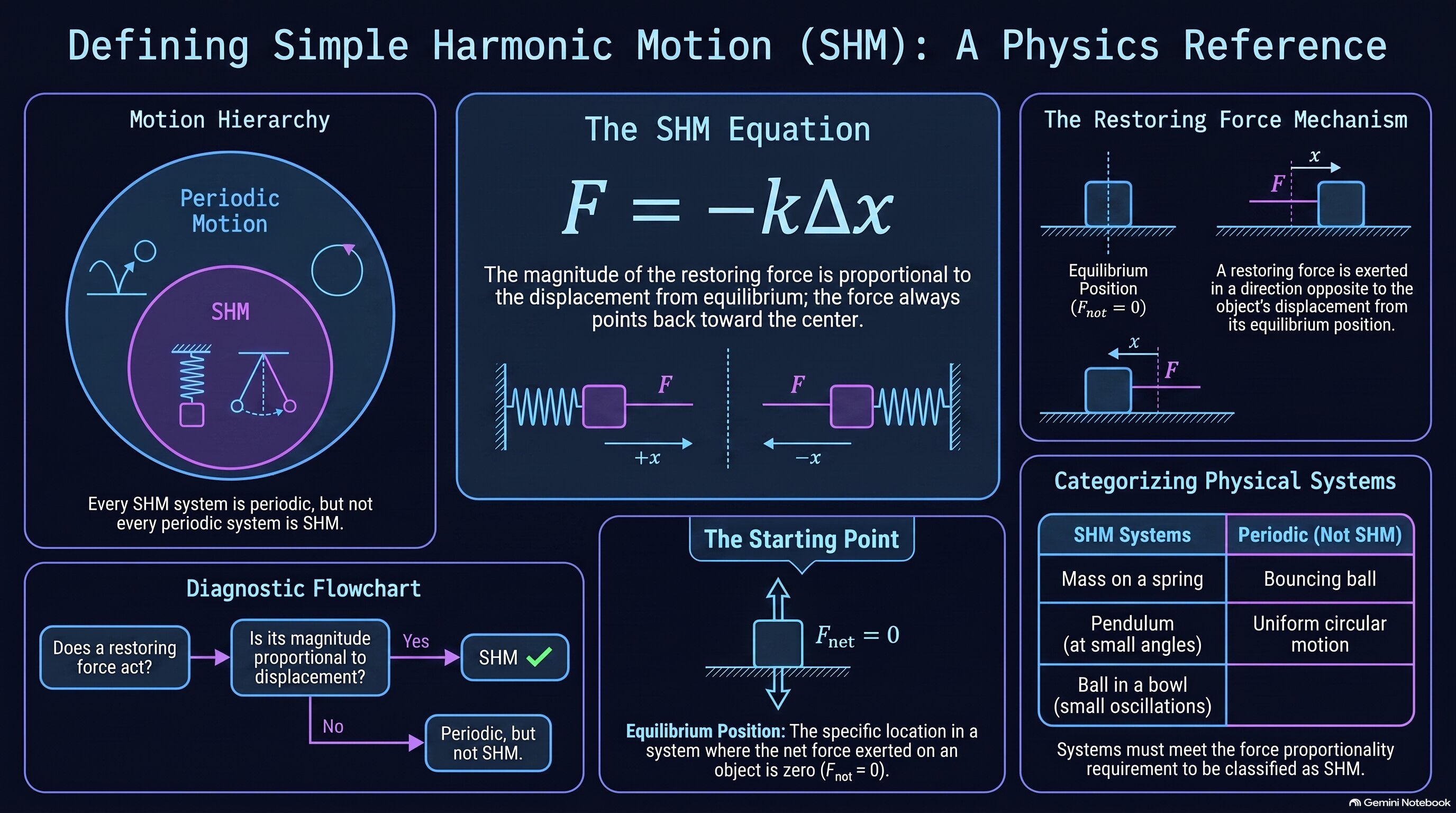
Unit 7 is about oscillations — motion that repeats itself over and over. This lesson draws the boundary that matters for the rest of the unit: not all repeating motion is simple harmonic motion. SHM is a special case of periodic motion that happens whenever a system experiences a restoring force whose magnitude is directly proportional to how far the system has moved from its equilibrium position — the spot where the net force is zero. That single condition, F = −kΔx, is the test you'll use all unit long to recognize SHM wherever it shows up: springs, pendulums, and beyond.
What you'll do in this lesson
- Define periodic motion and identify SHM as a special case of it.
- State the SHM condition: F = −kΔx, a restoring force proportional to displacement from equilibrium.
- Explain why a restoring force must act opposite to an object's displacement.
- Define equilibrium position as the location where the net force on a system is zero.
- Classify example motions and force laws as SHM or not SHM, using the restoring-force condition as the test.
Why it matters
Every equation in Unit 7 — period, frequency, position-vs-time, energy — only applies once you've confirmed a system is actually undergoing SHM. This lesson is the checkpoint you'll come back to before using any of them.
✅ Self-Check Before You Oscillate
Check off each item as you get there. These aren't grades — they're your own signal.