Use this as a quick reference for what's conserved in circular vs. elliptical orbits, the gravitational PE convention, and escape velocity.
🧭 Plot Summary
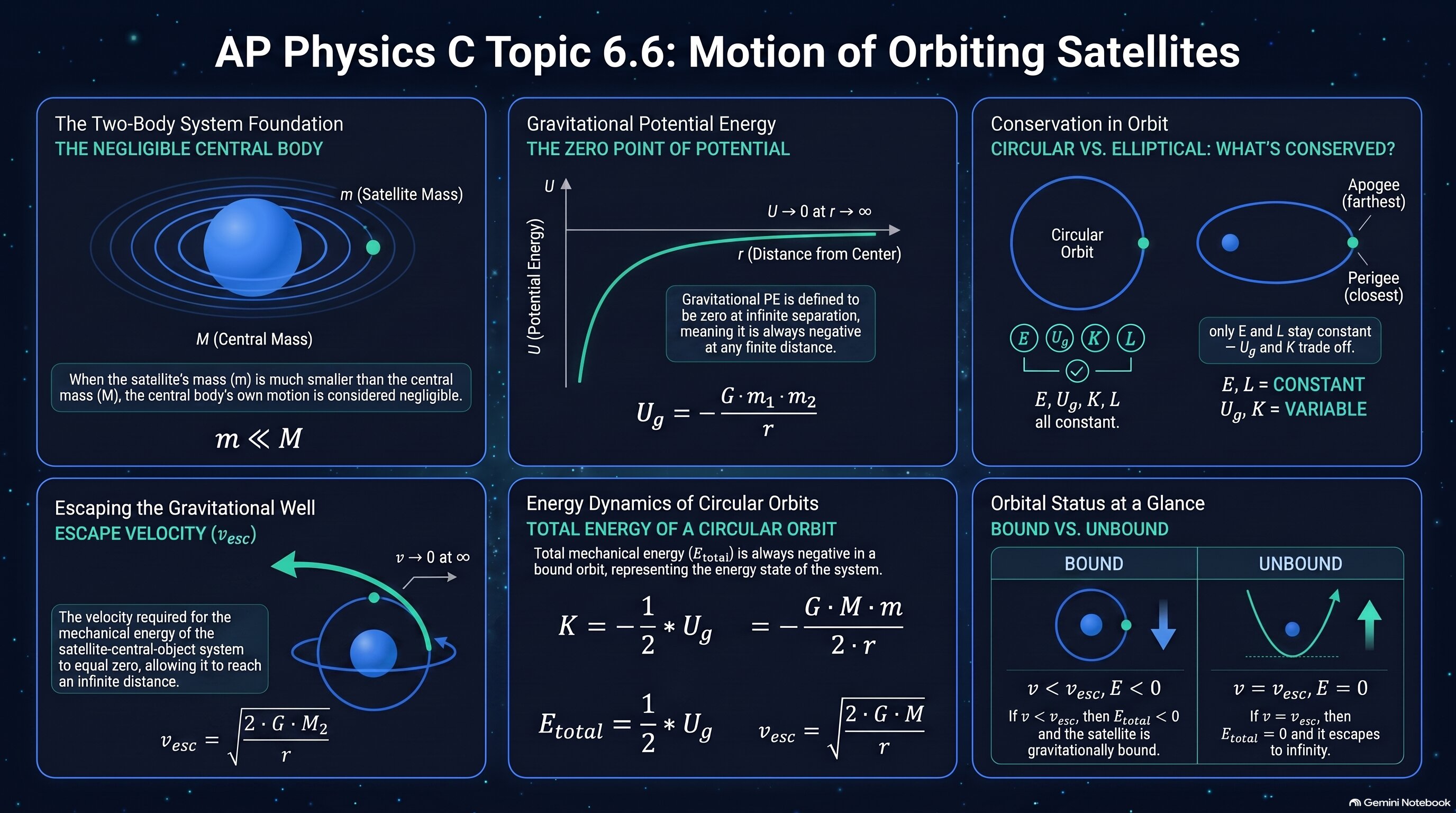
This lesson takes the conservation laws you've been building all unit — energy, and now angular momentum too — and applies them to a system you can't put on a lab table: a satellite orbiting a much more massive central body. Because the satellite's mass is negligible compared to the central object's, we can treat the central object as essentially fixed and describe the whole system's behavior through what stays constant. In a circular orbit, everything about the satellite's energy and angular momentum is constant. In an elliptical orbit, the total mechanical energy and angular momentum are still constant, but the split between kinetic and potential energy shifts as the satellite moves closer to or farther from the central body.
What you'll do in this lesson
- Treat the central body's motion as negligible when a satellite's mass is much smaller than the central body's mass.
- Identify which quantities are conserved in circular orbits versus elliptical orbits.
- Apply the convention that gravitational potential energy is zero at infinite separation: Ug = −Gm1m2/r.
- Relate a circular orbit's total energy to its kinetic and potential energy: Etotal = −K = ½U = −GMm/2r.
- Define escape velocity and derive vesc = √(2GM/r) from conservation of energy.
Why it matters
This lesson closes Unit 6 by reusing rotational motion, angular momentum, and energy conservation together in one scenario — and it's the physics behind every satellite, moon, and planet you'll ever hear about.
✅ Self-Check Before You Launch
Check off each item as you get there. These aren't grades — they're your own signal.