Use this as a quick reference for when — and why — angular momentum stays constant.
🧭 Plot Summary
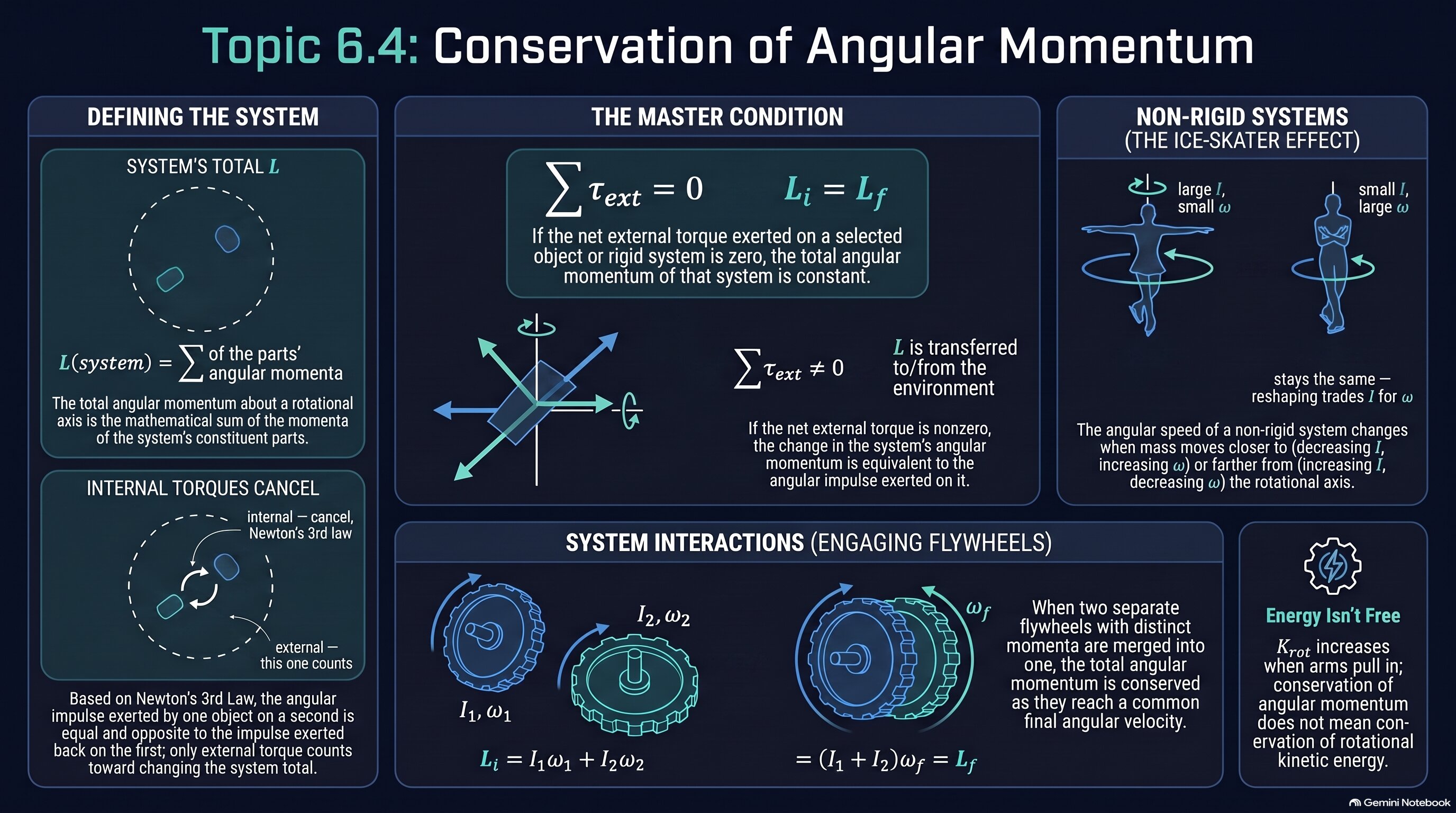
This is the payoff lesson for everything Unit 6 has built so far. A system's total angular momentum is just the sum of its parts' angular momenta — and any torques the parts exert on each other cancel in equal-and-opposite pairs, courtesy of Newton's third law, so they can never change that total. Only a torque from outside the system can do that. Pick a system with zero net external torque, and its angular momentum is locked in place: Στext = 0 ⟹ Li = Lf — even while the system reshapes itself, spins up, slows down, or merges with something else. A skater pulling in their arms doesn't add any angular momentum by doing that; they just redistribute their mass, and their spin speeds up to compensate. Two flywheels engaging a clutch don't add angular momentum either — they just share what they already had.
What you'll do in this lesson
- Recognize the total angular momentum of a system as the sum of the angular momenta of its parts.
- Explain why internal torques cancel in equal-and-opposite pairs and can't change a system's total L.
- Explain how a nonrigid system's angular speed can change without its angular momentum changing.
- Apply the conservation condition: zero net external torque means constant total angular momentum.
- Solve problems where systems combine (engaging flywheels) or reconfigure (a skater pulling in their arms).
Why it matters
Conservation of angular momentum is one of the most tested ideas in Unit 6 — and it sets up Lesson 6.5's treatment of rolling, where you'll track both linear and angular momentum-like quantities at once.
✅ Self-Check Before You Roll On
Check off each item as you get there. These aren't grades — they're your own signal.