Use this as a quick reference for how torque does work on a rotating system.
🧭 Plot Summary
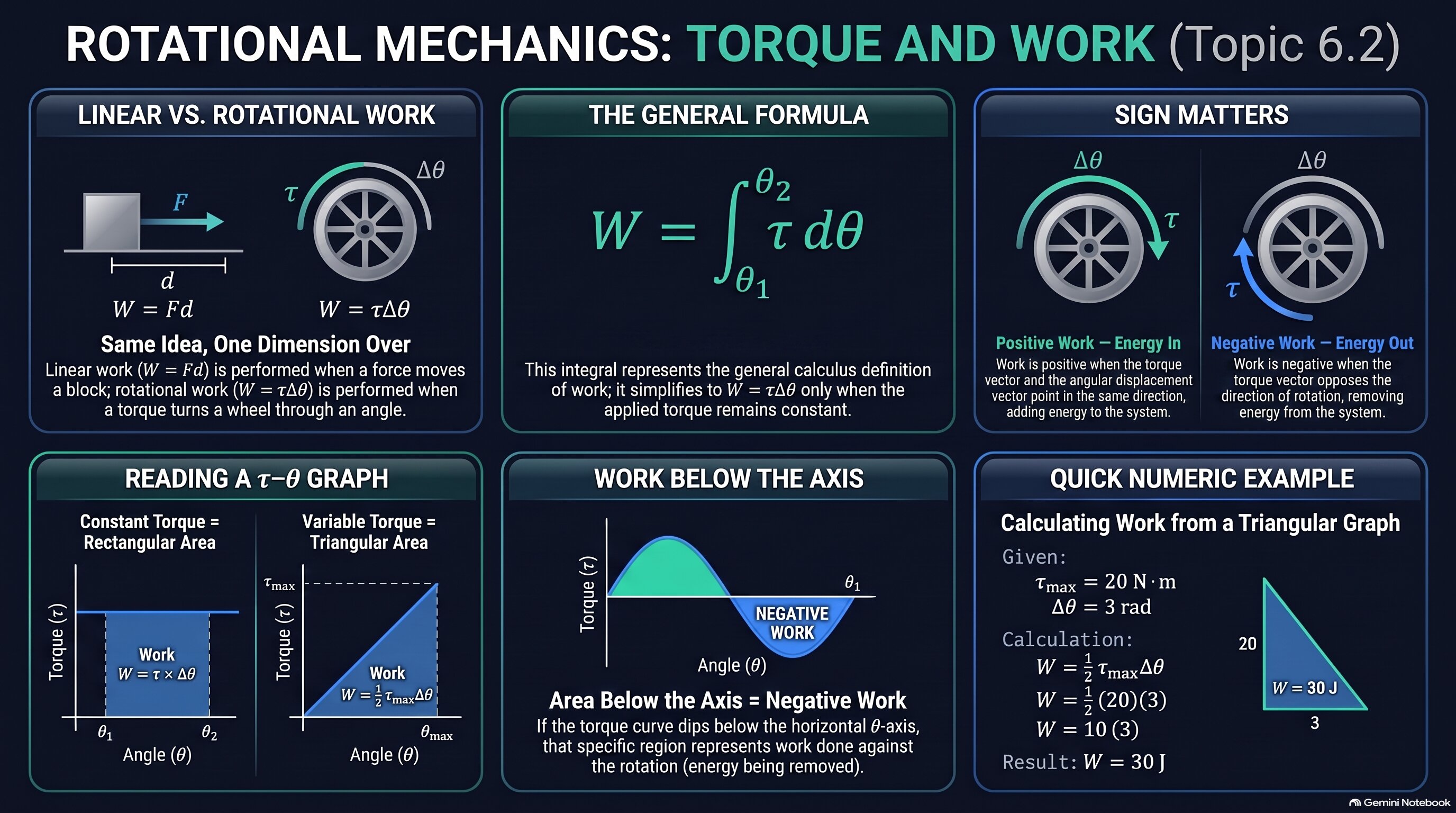
In Lesson 6.1 you learned that a rotating system carries kinetic energy. This lesson asks where that energy comes from: a torque. Just like a force does work when it pushes something through a displacement, a torque does work when it rotates something through an angular displacement. The relevant equation, W = ∫τ dθ, simplifies to W = τΔθ whenever the torque stays constant — and just like linear work, this work can also be read straight off a graph: it's the area under a curve of torque plotted against angular position.
What you'll do in this lesson
- Explain how a torque transfers energy into or out of a system when exerted over an angular displacement.
- Calculate work done by a torque using W = ∫τ dθ, simplifying to W = τΔθ when the torque is constant.
- Determine whether a torque's work is positive or negative from its direction relative to the rotation.
- Find the work done by a torque — including a non-constant one — from the area under a τ-vs-θ graph.
Why it matters
Torque doing work is the bridge between the forces you've been analyzing since Unit 5 and the rotational kinetic energy you just met in 6.1 — it's the mechanism that actually changes a system's Krot. It also sets up the angular impulse work in 6.3, where torque exerted over time (rather than angle) changes a system's angular momentum instead.
✅ Self-Check Before You Roll On
Check off each item as you get there. These aren't grades — they're your own signal.