Use this as a quick reference for rotational KE and how it fits into a system's total kinetic energy.
🧭 Plot Summary
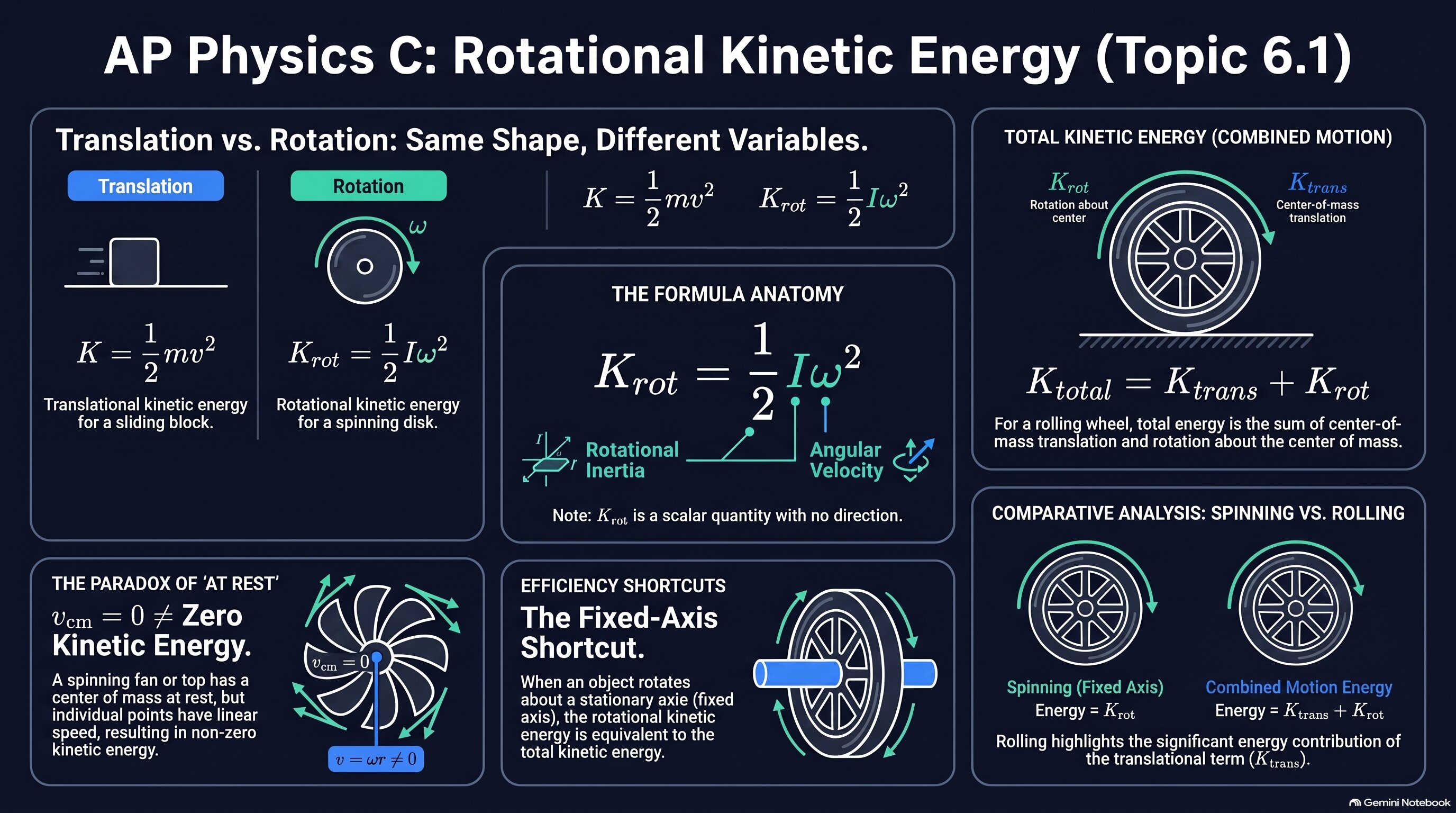
Welcome to Unit 6 — where the energy and momentum tools you built for translational motion (Units 3 and 4) and the torque tools you just built in Unit 5 come together. A spinning object carries kinetic energy just like a moving one does, given by Krot = ½Iω² — the rotational twin of the familiar K = ½mv². Because rotational KE is a scalar, there's no direction to track, only magnitude. For a system that's both rotating and translating — a rolling wheel, a thrown baseball spinning through the air — the total kinetic energy is simply the sum of the translational KE of its center of mass and the rotational KE about that center of mass. And a system doesn't even need to be going anywhere to have rotational KE: a fan spinning in place has kinetic energy in every one of its blades, even though its center of mass never moves at all.
What you'll do in this lesson
- Calculate an object's or system's rotational kinetic energy from its rotational inertia and angular velocity.
- Recognize rotational kinetic energy as a scalar — magnitude only, never a direction.
- Show that for an object rotating about a fixed axis, rotational KE equals its total KE.
- Break the total KE of a rolling or spinning rigid system into translational KE (of the center of mass) and rotational KE (about the center of mass).
- Explain why a system can have rotational KE even when its center of mass isn't moving at all.
Why it matters
This lesson sets up the energy vocabulary that the rest of Unit 6 depends on — from torque doing work (6.2) to angular momentum and impulse (6.3) to conservation of angular momentum (6.4) to rolling without slipping (6.5), where translational and rotational kinetic energy finally combine in one equation.
✅ Self-Check Before You Roll On
Check off each item as you get there. These aren't grades — they're your own signal.