Use this as a quick reference for τ = Iα and applying it to pulleys with mass and friction.
🧭 Plot Summary
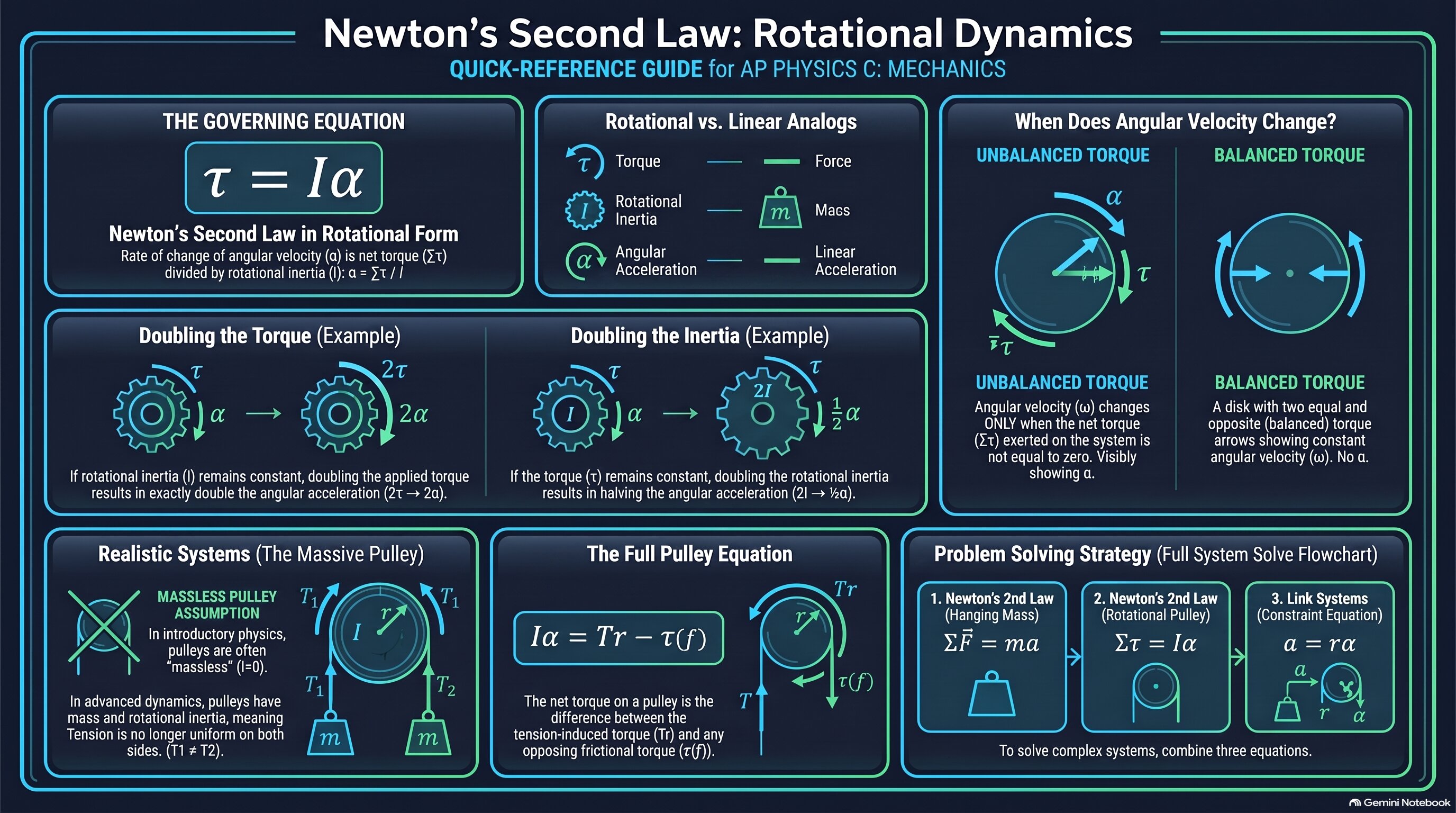
This lesson is Unit 5's payoff — the moment torque (5.3), rotational inertia (5.4), and equilibrium (5.5) all come together into one master equation. Just as F=ma tied Unit 2 together, τ(net) = Iα ties Unit 5 together: angular velocity changes precisely when net torque is nonzero, and the rate of that change is directly proportional to torque and inversely proportional to rotational inertia. This lesson also revisits an old friend from Lesson 2.5 — the pulley — except this time the pulley itself has mass and rotational inertia, no longer the ideal, massless pulley Unit 2 always assumed.
What you'll do in this lesson
- Identify when a system's angular velocity is changing.
- State and apply Newton's second law in rotational form, τ(net) = Iα.
- Explain the proportional relationship between torque, angular acceleration, and rotational inertia.
- Apply τ = Iα to pulleys with mass and friction, connecting rotational and linear motion.
- Compare angular accelerations across different torque and rotational-inertia scenarios.
Why it matters
τ = Iα is the single most reused equation for the rest of the course whenever a rigid system's rotation is changing — it's also exactly what makes Lesson 5.5's equilibrium condition (Στ = 0) a special case of this broader law, α = 0.
✅ Self-Check Before You Roll On
Check off each item as you get there. These aren't grades — they're your own signal.