Use this as a quick reference for rotational equilibrium, its independence from translational equilibrium, and the rotational form of Newton's first law.
🧭 Plot Summary
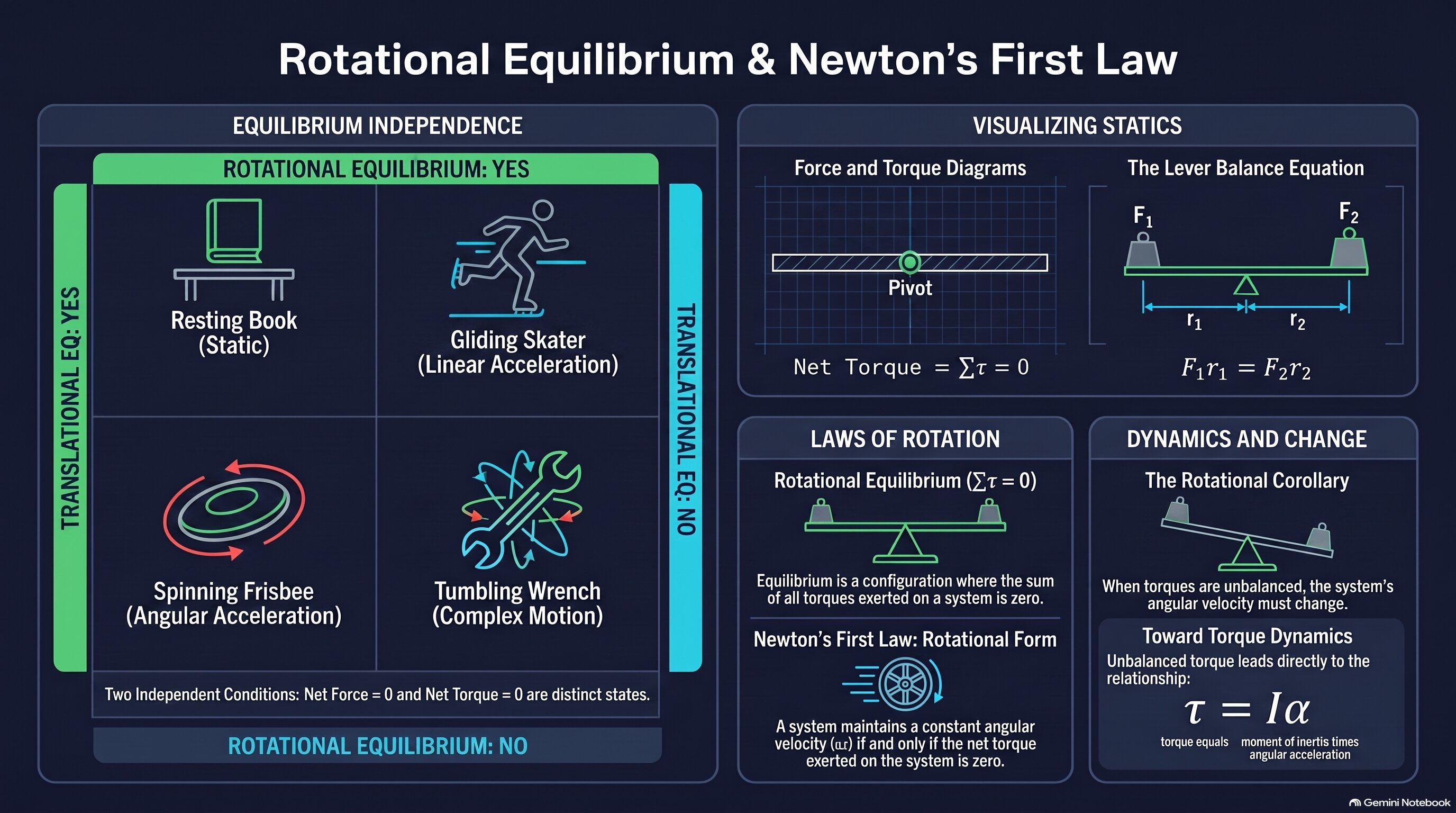
This lesson is Lesson 2.4 all over again — just spinning. Rotational equilibrium means the net torque on a system is exactly zero, Στ = 0, and the rotational version of Newton's first law follows directly: a system's angular velocity stays constant only when that condition holds. But here's the twist worth sitting with: rotational equilibrium and translational equilibrium are completely independent conditions. A system can be in one without the other — spinning at a perfectly constant rate while its center of mass accelerates, or sitting translationally still while torques quietly fight for control of its spin.
What you'll do in this lesson
- Explain why rotational and translational equilibrium are separate, independent conditions.
- Draw force and torque diagrams for rigid systems.
- Apply Στ = 0 to solve balance problems, including lever and seesaw setups.
- State the rotational form of Newton's first law.
- Recognize that unbalanced torque means changing angular velocity.
Why it matters
Static equilibrium problems — seesaws, beams, ladders leaning on walls — are classic AP FRQ territory, and they almost always require balancing force and torque simultaneously, exactly the two independent conditions this lesson sets up.
✅ Self-Check Before You Roll On
Check off each item as you get there. These aren't grades — they're your own signal.