Use this as a quick reference for point-mass rotational inertia, the continuous integral, and common-shape formulas.
🧭 Plot Summary
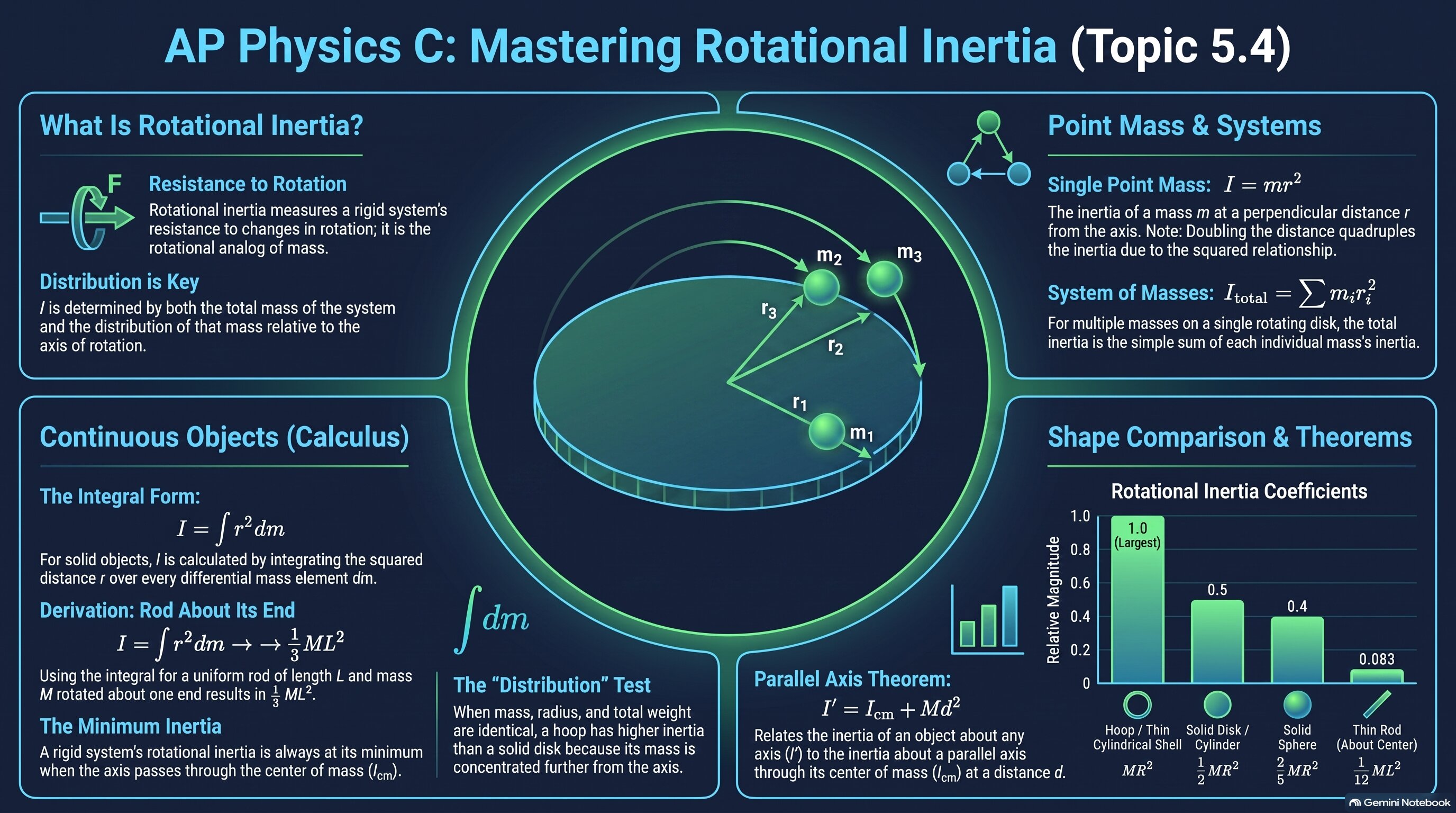
Rotational inertia is mass's answer to Unit 2's story — a measure of how strongly a rigid system resists having its rotation changed. But unlike ordinary mass, rotational inertia cares about more than just "how much": it cares deeply about where that mass actually sits relative to the axis of rotation. For a point mass, I = mr² — and the farther out that mass sits, the more it contributes, growing with the square of its distance. For a system of several point masses, you simply add up each one's contribution. And for a solid object made of continuous, spread-out mass, the sum becomes an integral: I = ∫r² dm — exactly the calculus shown throughout this unit's own header art.
What you'll do in this lesson
- Define rotational inertia and explain what it physically measures.
- Calculate rotational inertia for point masses and systems of point masses.
- Calculate rotational inertia for continuous objects using integration.
- Compare rotational inertia across common shapes with the same mass and size.
- Explain qualitatively why mass distribution matters as much as total mass.
Why it matters
Rotational inertia is the "m" in the rotational version of Newton's second law (Lesson 5.6) — everything from here forward about how hard it is to spin something up traces directly back to this lesson.
✅ Self-Check Before You Roll On
Check off each item as you get there. These aren't grades — they're your own signal.