Use this as a quick reference for lever arms, force diagrams, and the cross product.
🧭 Plot Summary
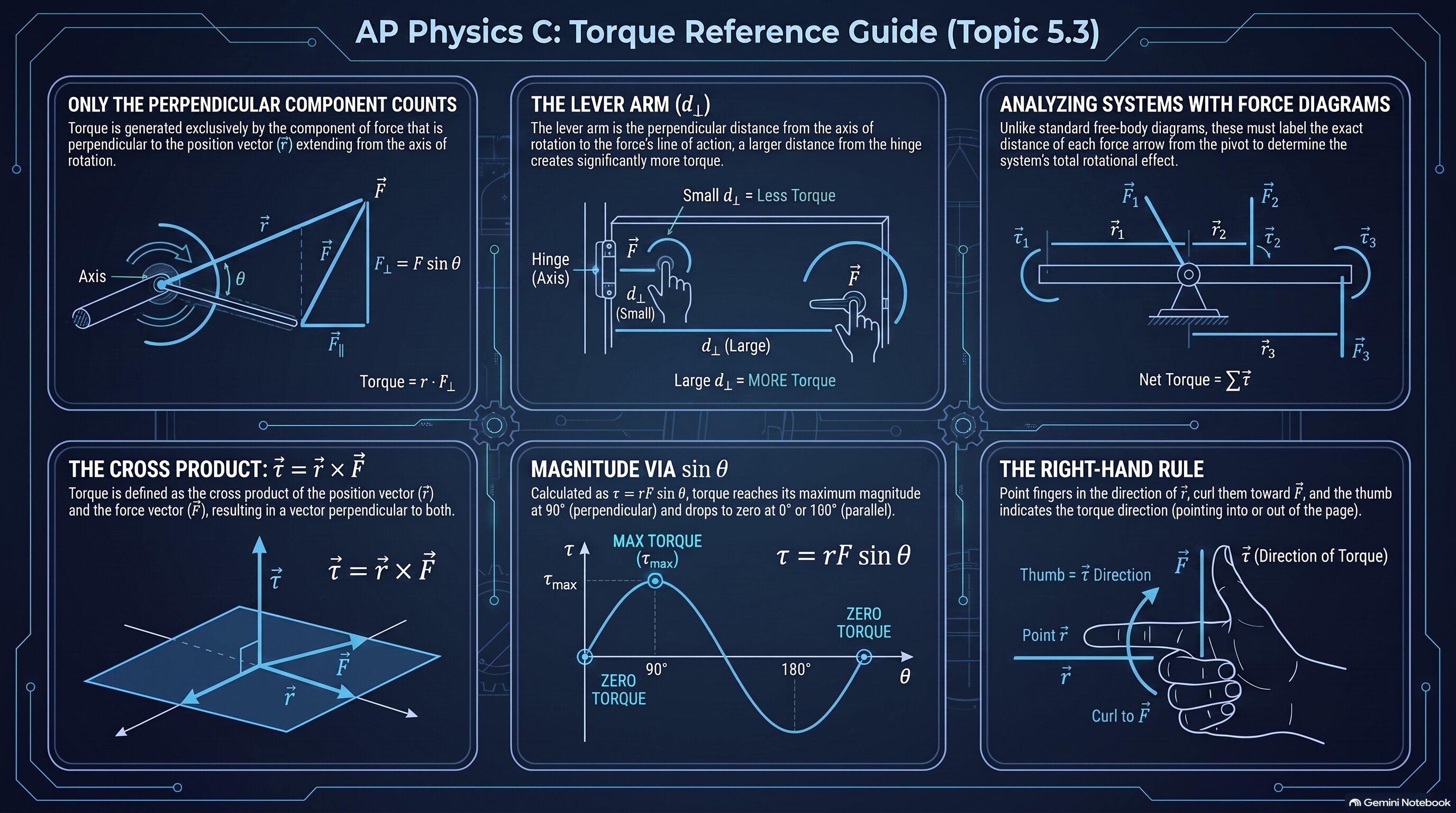
Torque is the rotational equivalent of force — but it comes with a catch. Only the component of a force that's perpendicular to the position vector from the axis of rotation to where the force is applied actually produces any rotation at all. That perpendicular distance has its own name — the lever arm — and it's the reason a door swings open so much more easily when you push near the handle than near the hinge. Formally, torque is defined by the cross product, τ⃗ = r⃗ × F⃗, which hands you both a magnitude (via rF sin θ) and a direction (via the right-hand rule) in one single vector operation.
What you'll do in this lesson
- Identify which component of a force actually produces torque.
- Calculate the lever arm for a given force and axis of rotation.
- Draw force diagrams showing forces and their locations relative to an axis.
- Calculate torque using the cross product, both magnitude and direction.
- Apply the right-hand rule to determine a torque's rotational direction.
Why it matters
Torque is the force that drives every rotational dynamics problem for the rest of this unit — rotational inertia (5.4), rotational equilibrium (5.5), and Newton's second law in rotational form (5.6) all revolve entirely around this one quantity.
✅ Self-Check Before You Roll On
Check off each item as you get there. These aren't grades — they're your own signal.