Use this as a quick reference for angular displacement, velocity, acceleration, and the rotational kinematics equations.
🧭 Plot Summary
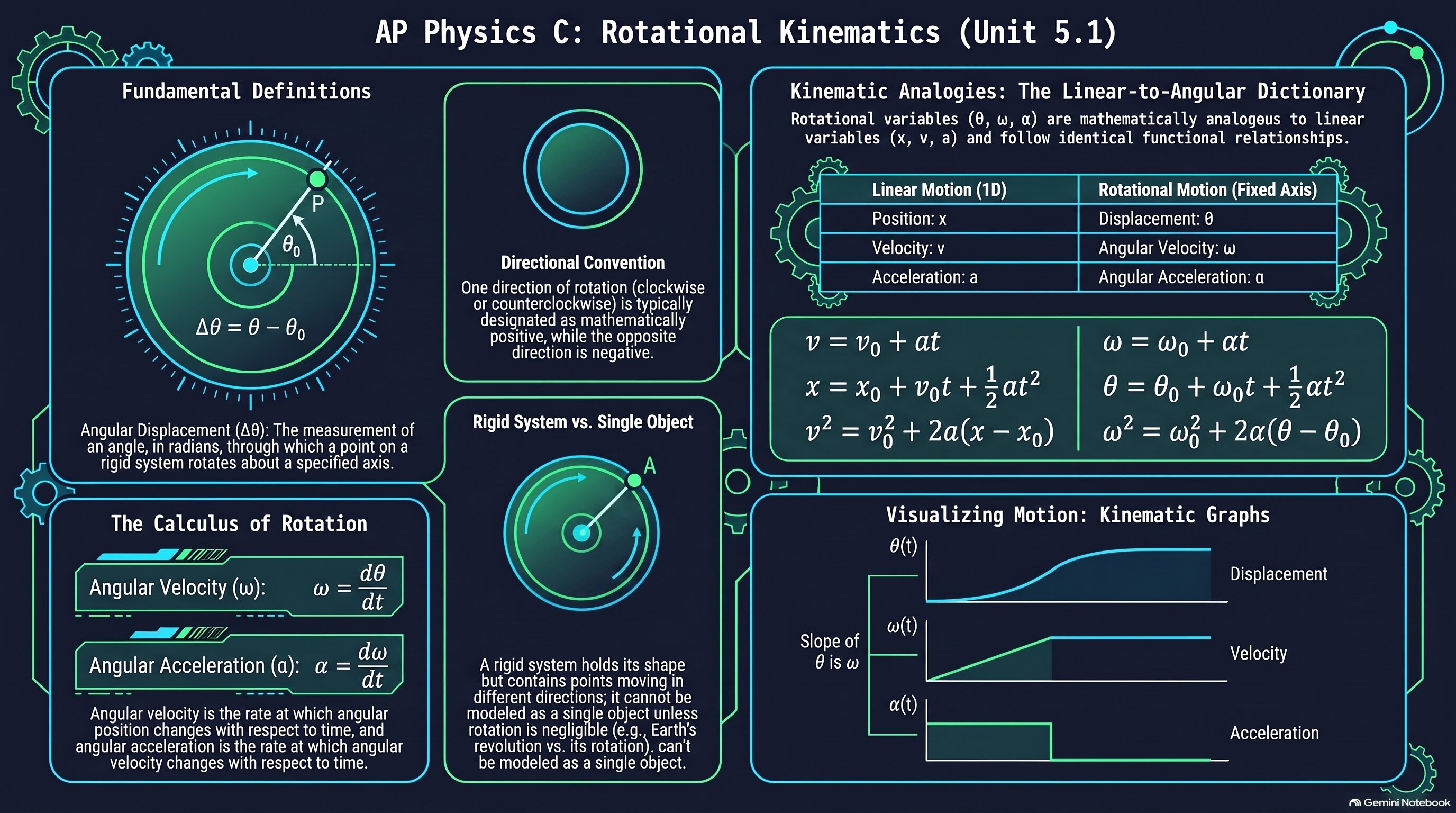
Welcome to Unit 5 — where everything you already know about motion learns to spin. A rigid system is any object where different points move in different directions during rotation, which means it can't be treated as a single point the way objects could in Units 1 through 4. But the math describing that rotation is a near-perfect mirror of what you already mastered: angular displacement (Δθ) plays the role of Δx, angular velocity (ω = dθ/dt) plays the role of v, and angular acceleration (α = dω/dt) plays the role of a. Even the constant-acceleration equations from Lesson 1.3 come back completely unchanged, just wearing Greek letters.
What you'll do in this lesson
- Define angular displacement and apply a sign convention for rotation direction.
- Distinguish a rigid system from an object, and know when each model applies.
- Calculate angular velocity and angular acceleration as rates of change.
- Recognize the direct analogy between angular and linear kinematics quantities.
- Apply the constant-angular-acceleration equations to solve rotational kinematics problems.
Why it matters
This lesson is the foundation for all of Unit 5 and Unit 6 — torque, rotational inertia, and rotational energy all build directly on the vocabulary established here.
✅ Self-Check Before You Roll On
Check off each item as you get there. These aren't grades — they're your own signal.