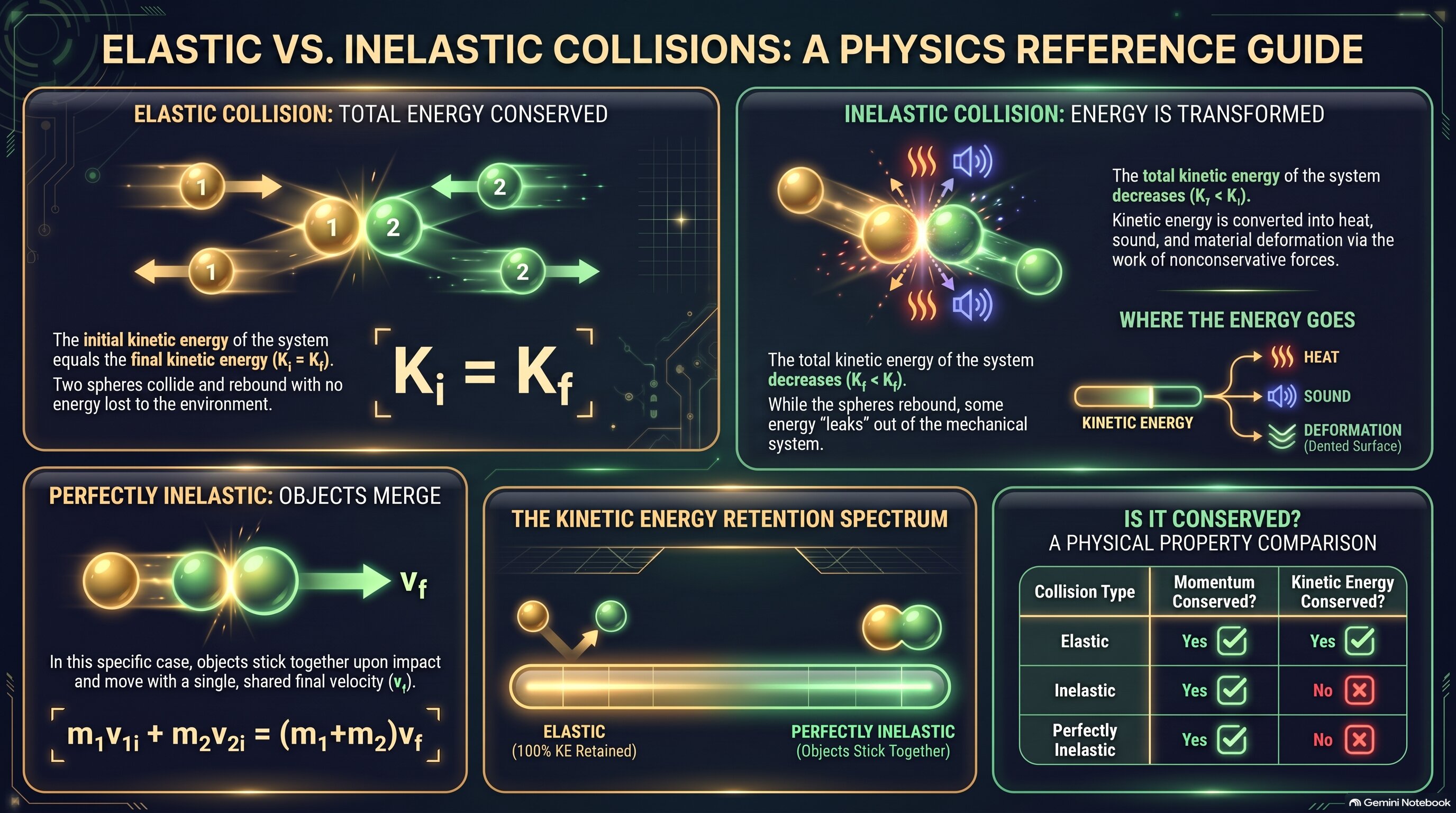
Use this as a quick reference for elastic, inelastic, and perfectly inelastic collisions.
🧭 Plot Summary
Here's the twist that closes out Unit 4: momentum is always conservedin an isolated collision — elastic, inelastic, doesn't matter. Kinetic energy is a completely different story. In an elastic collision, kinetic energy comes out exactly as it went in. In an inelastic collision, some of that kinetic energy simply doesn't come back — it's converted by nonconservative forces into heat, sound, or the permanent deformation of whatever collided. The most extreme case is a perfectly inelastic collision, where the objects stick together entirely and move off sharing one common final velocity — exactly the second scenario from this unit's own header art.
What you'll do in this lesson
Identify elastic collisions as ones where total kinetic energy is conserved.
Identify inelastic collisions as ones where total kinetic energy decreases.
Explain where the 'lost' kinetic energy in an inelastic collision actually goes.
Identify perfectly inelastic collisions as the special case where objects stick together.
Calculate final velocity and kinetic energy loss for a perfectly inelastic collision.
Why it matters
Confusing "momentum is conserved" with "kinetic energy is conserved" is one of the single most common errors on the whole AP exam. This lesson exists specifically to make that distinction impossible to forget.
✅ Self-Check Before You Roll On
Check off each item as you get there. These aren't grades — they're your own signal.