Use this as a quick reference for center-of-mass velocity, total momentum, and choosing an isolated system.
🧭 Plot Summary
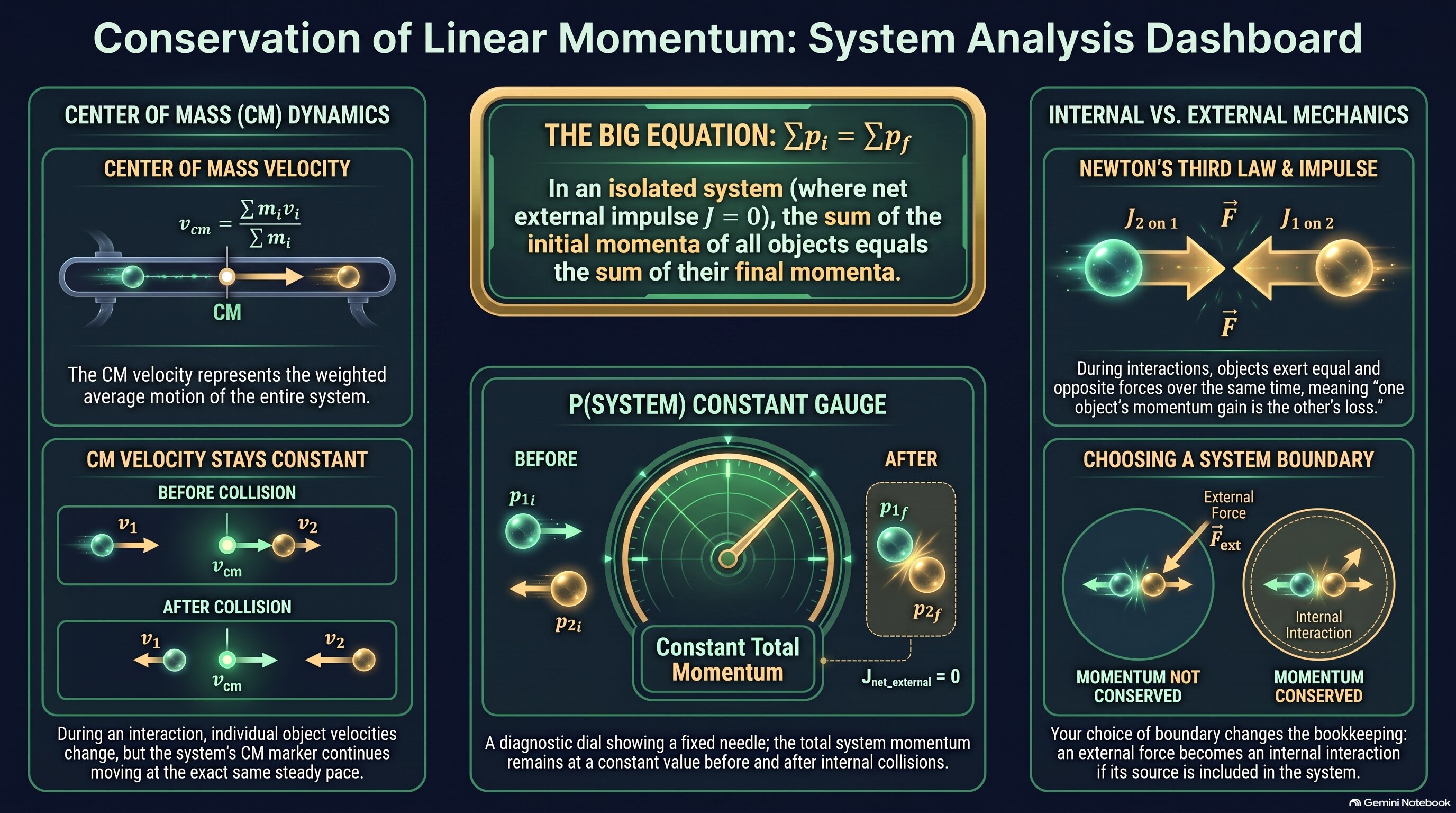
This is the centerpiece of Unit 4. A collection of objects, however chaotic their individual motions, can always be described as one system with a single center-of-mass velocity — and that velocity stays perfectly constant as long as no net external force acts on the system. Total momentum is just the sum of every object's own momentum, and here's the payoff: absent external forces, any momentum one object gains within the system is exactly balanced by momentum another object loses — a direct consequence of Newton's third law. Choose your system well, and its total momentum becomes a fixed, unshakeable number, letting you find unknown velocities before or after a collision or explosion without ever needing to know the messy details of the interaction itself.
What you'll do in this lesson
- Calculate a system's center-of-mass velocity and explain when it stays constant.
- Find a system's total momentum as the sum of its parts.
- Explain how momentum changes are balanced within an isolated system, via Newton's third law.
- Choose a system so that conservation of momentum applies cleanly.
- Apply conservation of momentum to find unknown velocities before or after collisions and explosions.
Why it matters
Conservation of momentum is, alongside conservation of energy, one of the two most powerful problem-solving tools in all of mechanics — and it's about to make every collision and explosion problem in Lesson 4.4 dramatically more tractable.
✅ Self-Check Before You Roll On
Check off each item as you get there. These aren't grades — they're your own signal.