Use this as a quick reference for momentum's definition, and the collision and explosion models.
🧭 Plot Summary
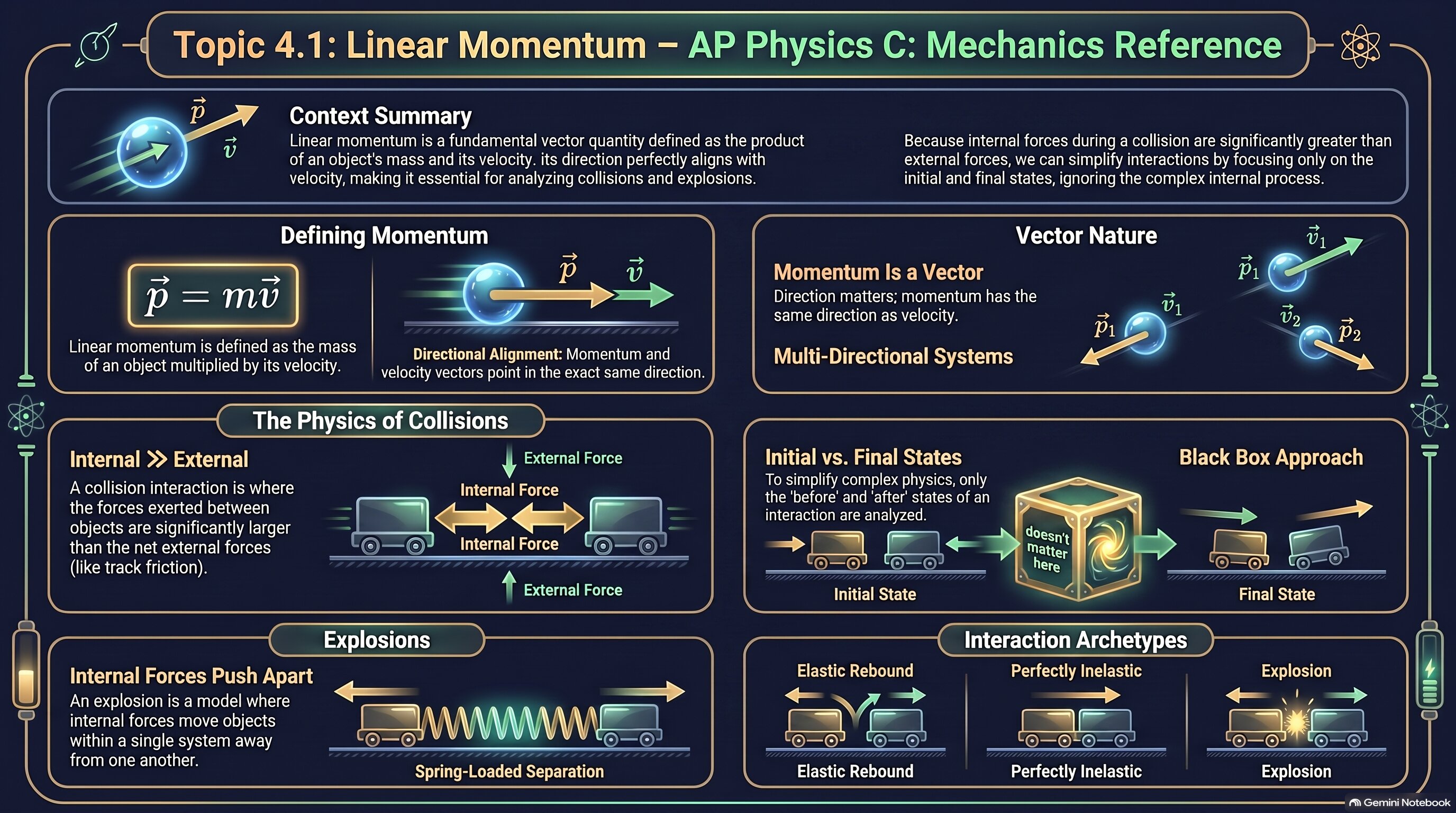
Welcome to Unit 4 — a whole unit built around one new vector quantity: linear momentum, p⃗ = mv⃗. It's simple to calculate, but it opens the door to analyzing two of the most dramatic interactions in mechanics. A collision is a brief, intense interaction where the internal forces between two objects vastly outweigh anything external — think of two carts smashing into each other on a track, exactly like this unit's header art. Because everything interesting happens in that brief instant, you only need to track initial and final states — the object model applies cleanly. An explosion is the mirror image: internal forces pushing objects within a system apart, rather than together.
What you'll do in this lesson
- Calculate an object's or system's linear momentum from its mass and velocity.
- Recognize momentum as a vector, always aligned with velocity's direction.
- Identify a collision as a brief interaction where internal forces dominate over external forces.
- Apply the object model to collisions by focusing only on initial and final states.
- Identify an explosion as internal forces separating objects within a system.
Why it matters
This lesson sets up the vocabulary — collision, explosion, the object model — that every remaining lesson in Unit 4 depends on, from impulse (4.2) to conservation of momentum (4.3) to classifying collisions as elastic or inelastic (4.4).
✅ Self-Check Before You Roll On
Check off each item as you get there. These aren't grades — they're your own signal.