Use this as a quick reference for average power, instantaneous power, and finding velocity from a power function.
🧭 Plot Summary
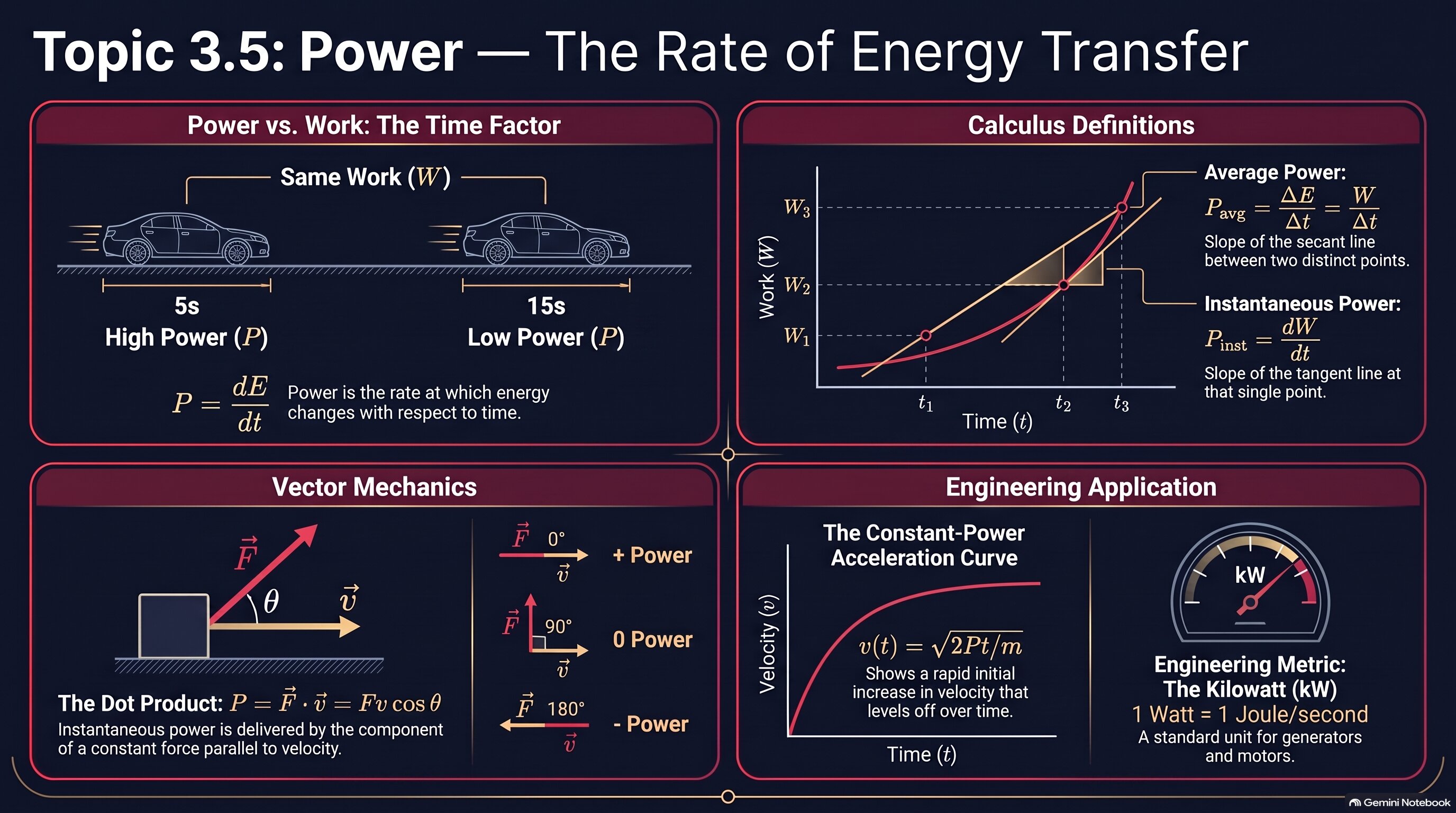
Power closes out Unit 3 by asking a question none of the previous lessons quite answered: not how much energy moved, but how fast it moved. Average power is just energy (or work) divided by the time it took — simple division. Instantaneous power reaches for calculus again, this time as a derivative of work with respect to time, which — for a constant force — collapses into a clean dot product between force and velocity: P = Fv cos θ, echoing the same structure you already know from work in Lesson 3.2.
What you'll do in this lesson
- Define power as the rate of energy transfer or conversion.
- Calculate average power from energy or work divided by time.
- Calculate instantaneous power as the derivative of work with respect to time.
- Apply P = Fv cos θ to find power delivered by a constant force.
- Determine when a force delivers positive, negative, or zero power.
- Derive an object's velocity as a function of time from a power relationship.
Why it matters
Power is the quantity that actually shows up on engine spec sheets, electric bills, and light bulb packaging — it's the most immediately "real world" quantity in the entire unit, and it closes the loop connecting everything since Lesson 3.1 back to a single rate.
✅ Self-Check Before You Roll On
Check off each item as you get there. These aren't grades — they're your own signal.