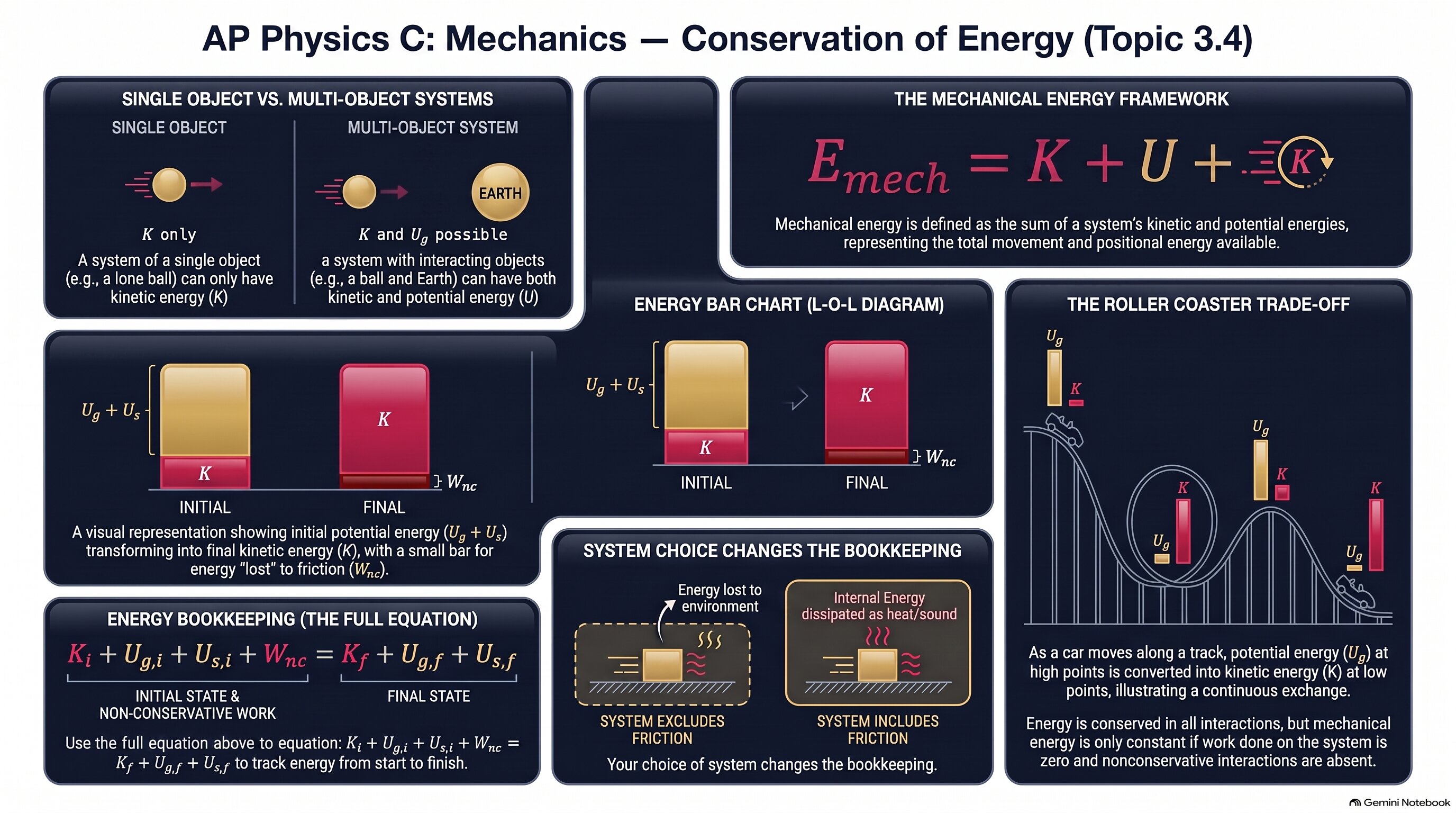
Use this as a quick reference for mechanical energy, choosing a system, and the full conservation of energy equation.
🧭 Plot Summary
Everything from Lessons 3.1 through 3.3 converges here. A system's mechanical energy is just kinetic plus potential energy — and the deep promise of this lesson is that energy is never created or destroyed, only converted between forms or transferred across a system's boundary. Choose your system wisely (echoing Lesson 2.1), and you can often set up a single equation — initial energy plus any nonconservative work equals final energy — and solve for whatever's missing, without ever touching kinematics or force diagrams directly.
What you'll do in this lesson
Identify what forms of energy a given system can have.
Define mechanical energy as the sum of kinetic and potential energy.
Explain how energy changes form within a system, or transfers between a system and its surroundings.
Choose a system so that conservation of energy applies cleanly.
Apply the full conservation of energy equation to solve for unknown quantities.
Represent energy transformations using energy bar charts.
Why it matters
Conservation of energy is arguably the single most powerful problem-solving tool in all of mechanics — many problems that look intimidating with forces and kinematics become almost trivial once you track energy instead.
✅ Self-Check Before You Roll On
Check off each item as you get there. These aren't grades — they're your own signal.