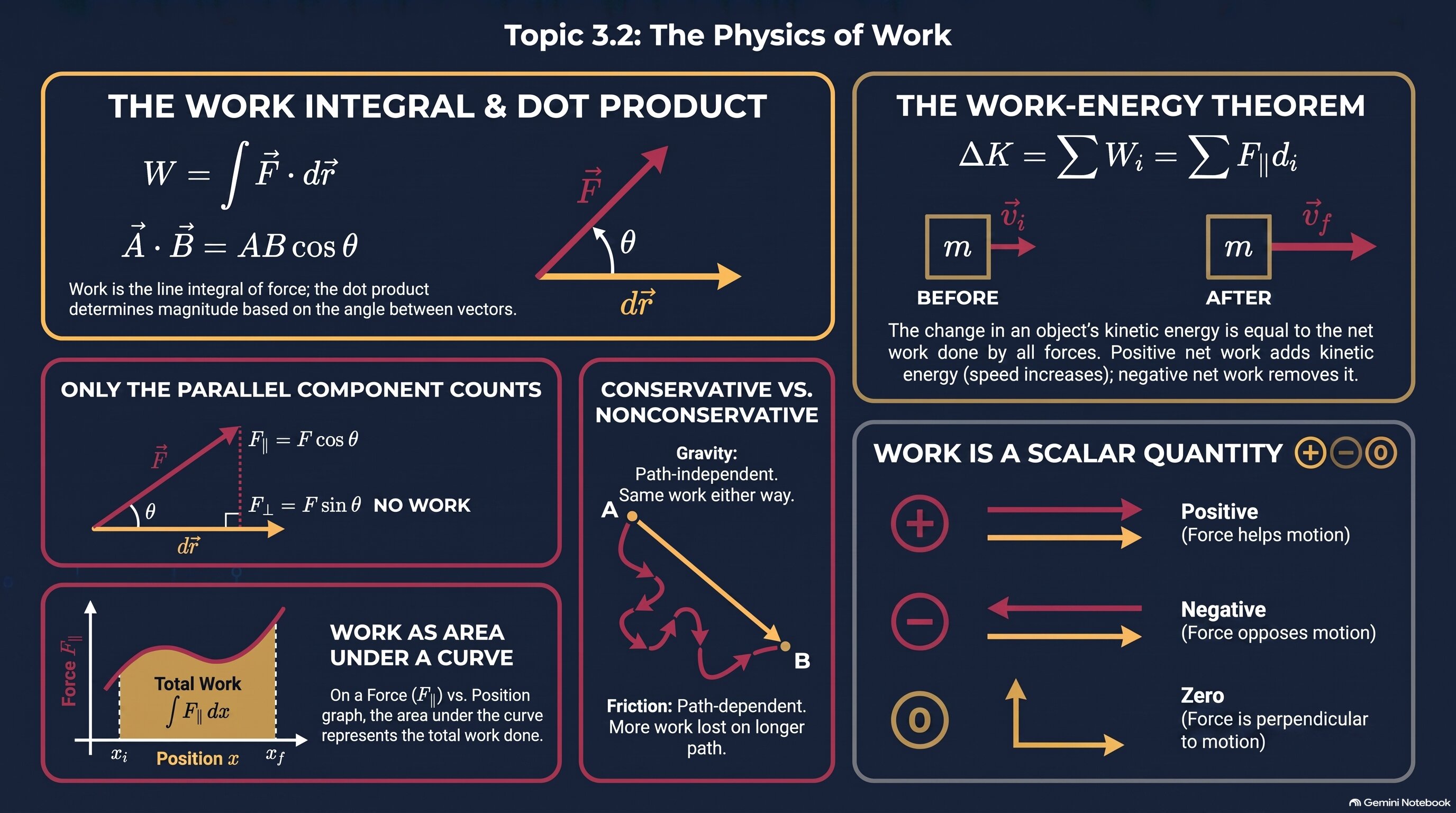
Use this as a quick reference for the work integral, the dot product, the work-energy theorem, and graphical work.
🧭 Plot Summary
Work is the bridge connecting force — everything you built in Unit 2 — to energy — everything the rest of Unit 3 is about. Work is the amount of energy a force transfers into or out of a system as that system moves through some distance. Some forces (conservative ones, like gravity and springs) do work that only cares about start and end points; others (nonconservative, like friction) do work that depends on the entire path taken. Calculating work for a force that changes as an object moves means reaching for calculus — the work integral, built from the dot productbetween force and displacement. And once you know the total work done on an object, the work-energy theorem hands you its change in kinetic energy directly, no separate kinematics required.
What you'll do in this lesson
- Define work and distinguish conservative from nonconservative forces.
- Recognize work as a scalar that can be positive, negative, or zero.
- Compute work from a variable force using the work integral and the dot product.
- Explain why only the parallel component of a force does work.
- Apply the work-energy theorem to relate net work to a change in kinetic energy.
- Find energy dissipated by friction.
- Find work as the area under a force-vs-displacement graph.
Why it matters
The AP exam's very first free-response question every year is the Mathematical Routines question — and work is one of its favorite subjects. This lesson's integral, dot product, and work-energy theorem are directly, explicitly testable as multi-step derivations.
✅ Self-Check Before You Roll On
Check off each item as you get there. These aren't grades — they're your own signal.