Use this as a quick reference for kinetic energy, its scalar nature, and its dependence on reference frame.
🧭 Plot Summary
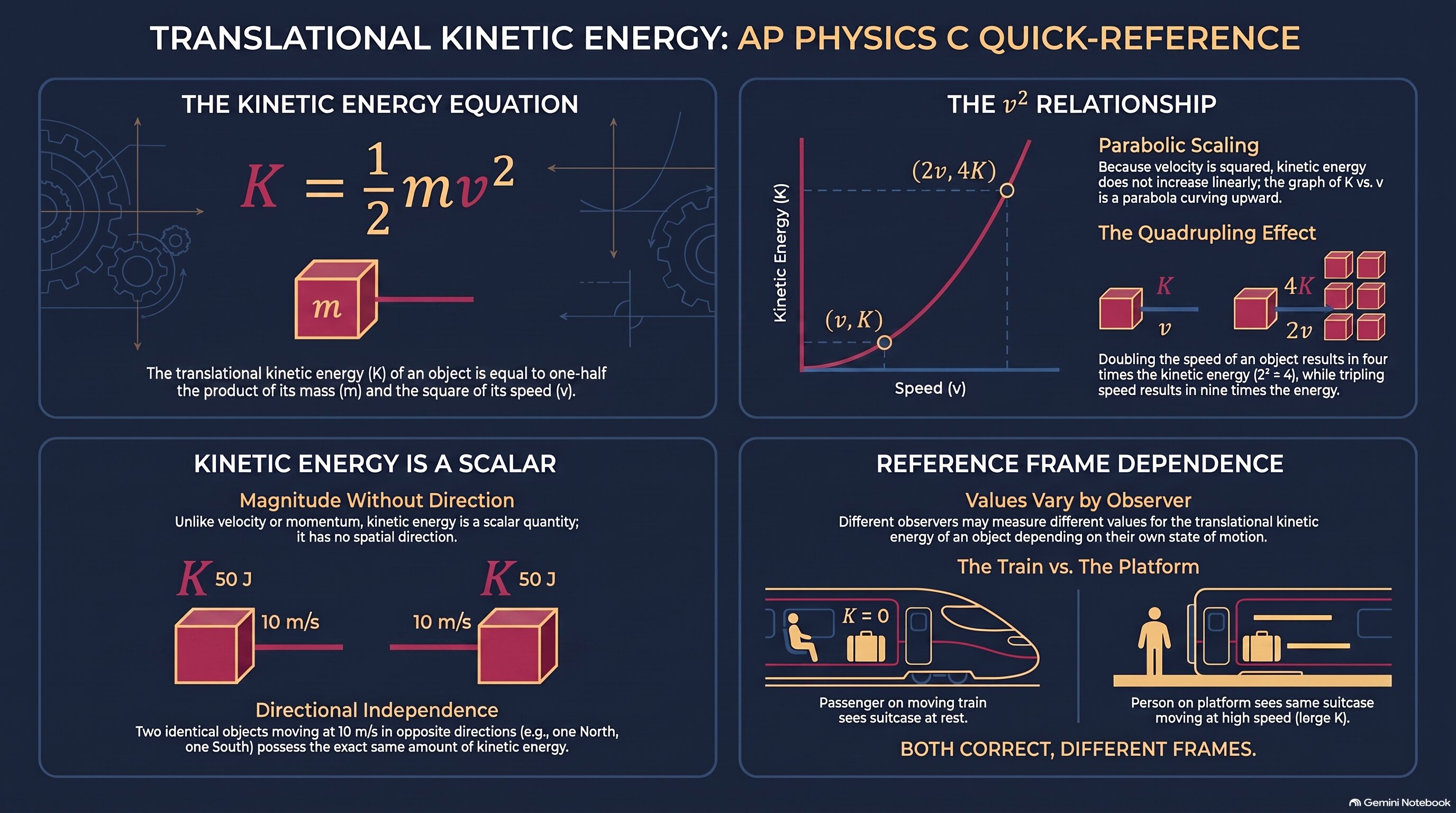
Welcome to Unit 3 — where force gives way to a new currency: energy. Translational kinetic energy is the energy an object has simply because it's moving, and it's refreshingly simple to calculate: K = ½mv². Two subtleties are worth catching early. First, kinetic energy is a scalar— no direction, ever, unlike the vectors you've been living in since Unit 1. Second, because velocity itself depends on reference frame (Lesson 1.4), so does kinetic energy — the same object can have different kinetic energy values for different observers, and neither observer is wrong.
What you'll do in this lesson
- Calculate translational kinetic energy from an object's mass and velocity.
- Recognize kinetic energy as a scalar — magnitude only, no direction.
- Explain the v² relationship: small changes in speed produce large changes in kinetic energy.
- Recognize that kinetic energy depends on the observer's reference frame.
Why it matters
Kinetic energy is the quantity every other topic in Unit 3 revolves around — Work (3.2) is defined as whatever changes it, and Conservation of Energy (3.4) tracks how it trades places with potential energy. Get comfortable with K = ½mv² now, because it appears in nearly every equation for the rest of the unit.
✅ Self-Check Before You Roll On
Check off each item as you get there. These aren't grades — they're your own signal.