Use this as a quick reference for setting up and solving the resistive-force differential equation, and for terminal velocity.
🧭 Plot Summary
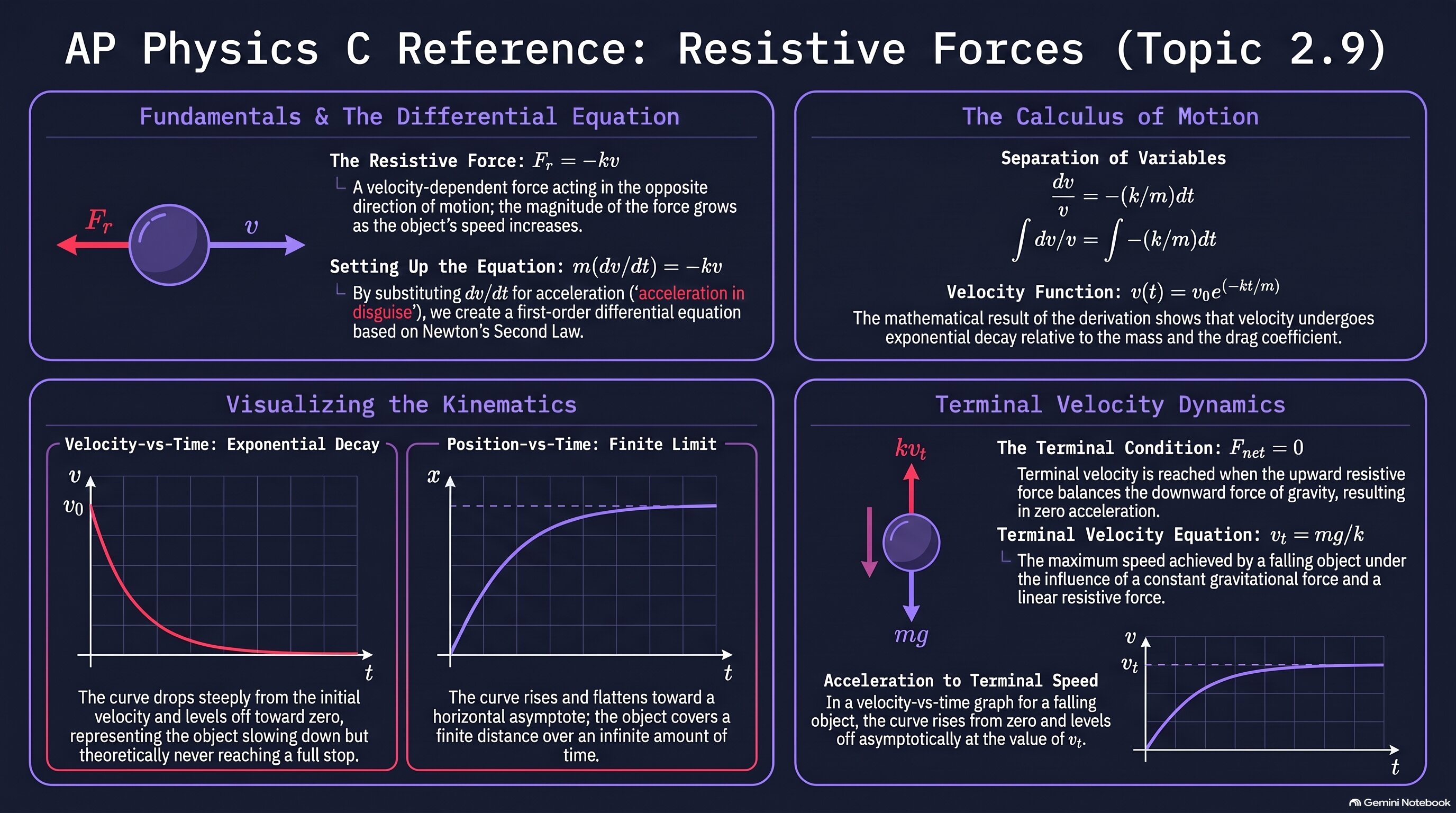
Every force law so far in this unit has been a plain algebra problem once you knew the setup. This one isn't. A resistive force depends on velocity itself — F = −kv is the simplest example — which means Newton's second law turns into an honest differential equation: acceleration (dv/dt) shows up on one side, velocity shows up tangled into the force on the other. Solving it means separating variables and integrating — real calculus, producing genuinely exponential velocity and position functions. And when a resistive force fights against a constant force like gravity, the object approaches a terminal velocity — a speed it gets closer and closer to forever, but (mathematically) never quite reaches.
What you'll do in this lesson
- Identify resistive forces as velocity-dependent forces opposing motion, such as F = −kv.
- Set up Newton's second law for a resistive force as a differential equation in velocity.
- Solve that differential equation using separation of variables.
- Integrate velocity to find position as a function of time, using initial conditions.
- Recognize the exponential form — and asymptotic behavior — of velocity and position under resistive forces.
- Define and calculate terminal velocity for an object experiencing both a constant force and a resistive force.
Why it matters
This is the first time in the course you'll solve a genuine differential equation by separating variables — a skill the AP exam explicitly calls out, and one that will reappear when you study oscillations later this year.
✅ Self-Check Before You Roll On
Check off each item as you get there. These aren't grades — they're your own signal.