Use this as a quick reference for Hooke's law and combining springs in series and parallel.
🧭 Plot Summary
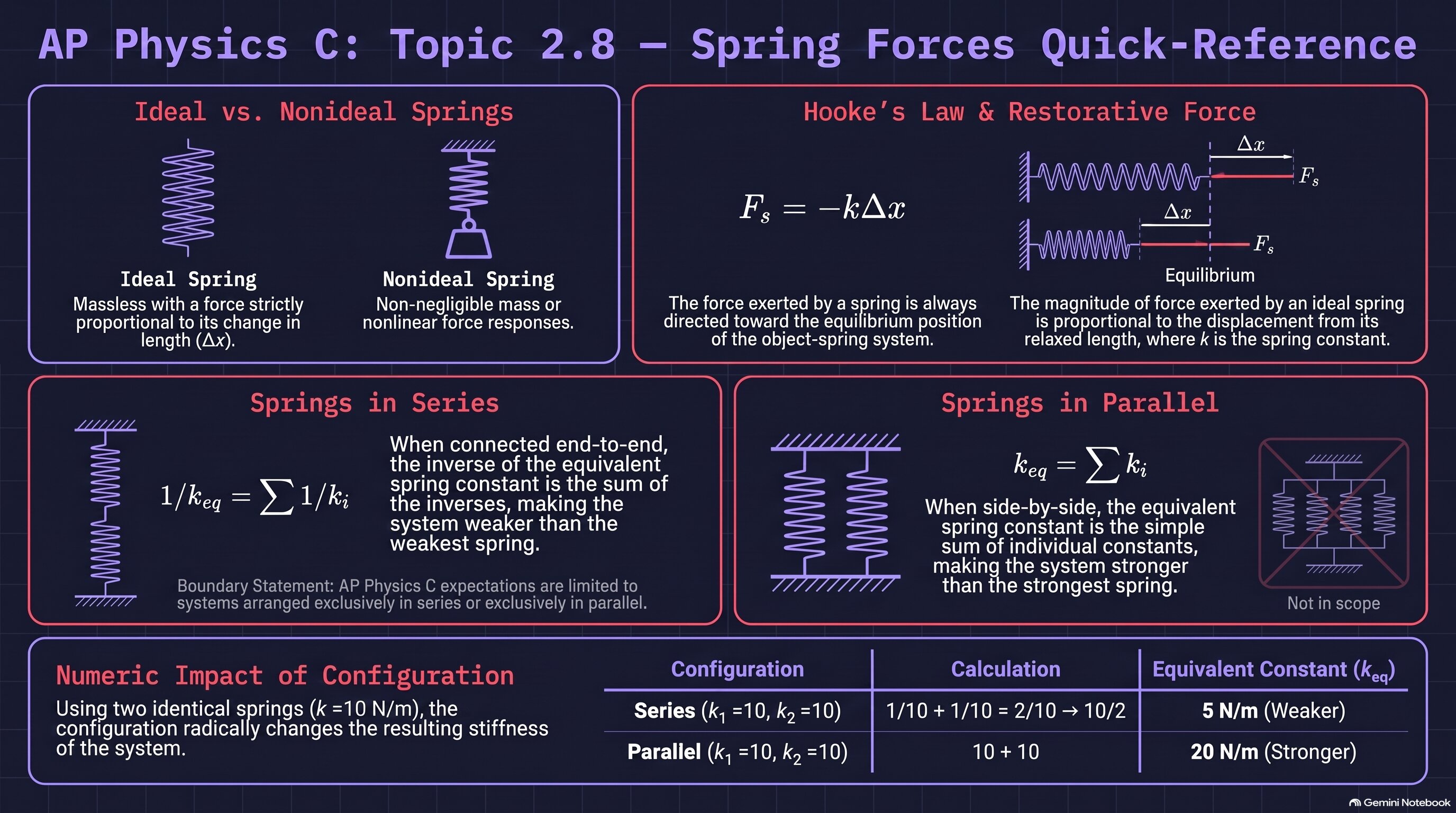
Springs are the most well-behaved force in this entire unit. An ideal spring exerts a force exactly proportional to how far it's stretched or compressed from its natural length — Hooke's law — and that force always points back toward equilibrium, trying to restore the spring to its relaxed state. The other half of this lesson is bookkeeping: when several springs act together, either end to end (series) or side by side (parallel), the whole combination behaves like one single spring with its own equivalent spring constant — and which arrangement you use changes whether that combined spring ends up weaker or stronger than any of its parts.
What you'll do in this lesson
- Distinguish ideal springs (massless, proportional force) from nonideal springs.
- Apply Hooke's law, Fs = −kΔx, to find the force an ideal spring exerts.
- Recognize that spring force always points back toward the equilibrium position.
- Combine springs in series and find the smaller equivalent spring constant that results.
- Combine springs in parallel and find the larger equivalent spring constant that results.
Why it matters
Hooke's law is the third specific force law in your F=ma toolkit, and it's also the mathematical seed of Unit 7 (Oscillations) — every simple harmonic motion problem later this year traces straight back to Fs = −kΔx.
✅ Self-Check Before You Roll On
Check off each item as you get there. These aren't grades — they're your own signal.