Use this as a quick reference for kinetic vs. static friction, the classic friction-vs-applied-force graph, and finding the slipping angle.
🧭 Plot Summary
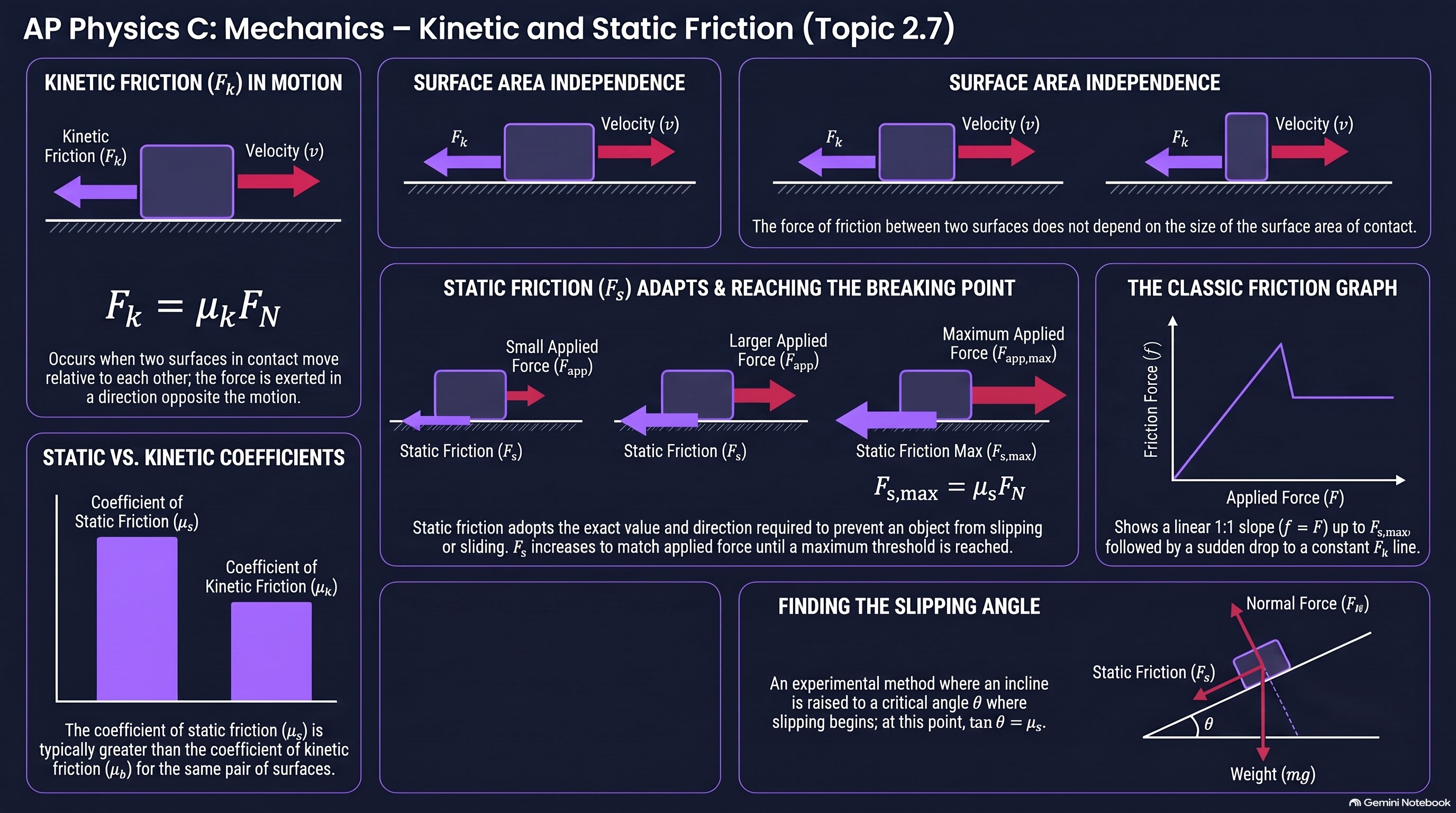
Friction comes in two personalities. Kinetic friction shows up once two surfaces are already sliding against each other — a fixed force, Fk = μₖN, always opposing the sliding motion. Static friction is stranger and more useful: it isn't one fixed value at all, but adapts to whatever magnitude and direction is needed to keep two surfaces from sliding — right up until it hits its maximum, μₛN, at which point the surfaces finally give way and start to slip. This single idea explains why you can push gently on a heavy box with nothing happening, then push slightly harder and have it suddenly lurch forward.
What you'll do in this lesson
- Identify kinetic friction as occurring only when surfaces slide relative to each other.
- Calculate kinetic friction force as Fk = μₖN, independent of contact area.
- Recognize normal force as the perpendicular contact force, directed away from the surface.
- Treat static friction as a variable force that matches whatever is needed to prevent slipping.
- Calculate the maximum static friction force, Fs,max = μₛN, and find the point where slipping begins.
- Explain why μₛ is typically greater than μₖ for the same pair of surfaces.
Why it matters
Friction is the second specific force law you're adding to your F=ma toolkit, after gravity. It's also the source of one of the most common setup mistakes on the AP exam: assuming static friction always equals μₛN, when really that's only its maximum possible value.
✅ Self-Check Before You Roll On
Check off each item as you get there. These aren't grades — they're your own signal.