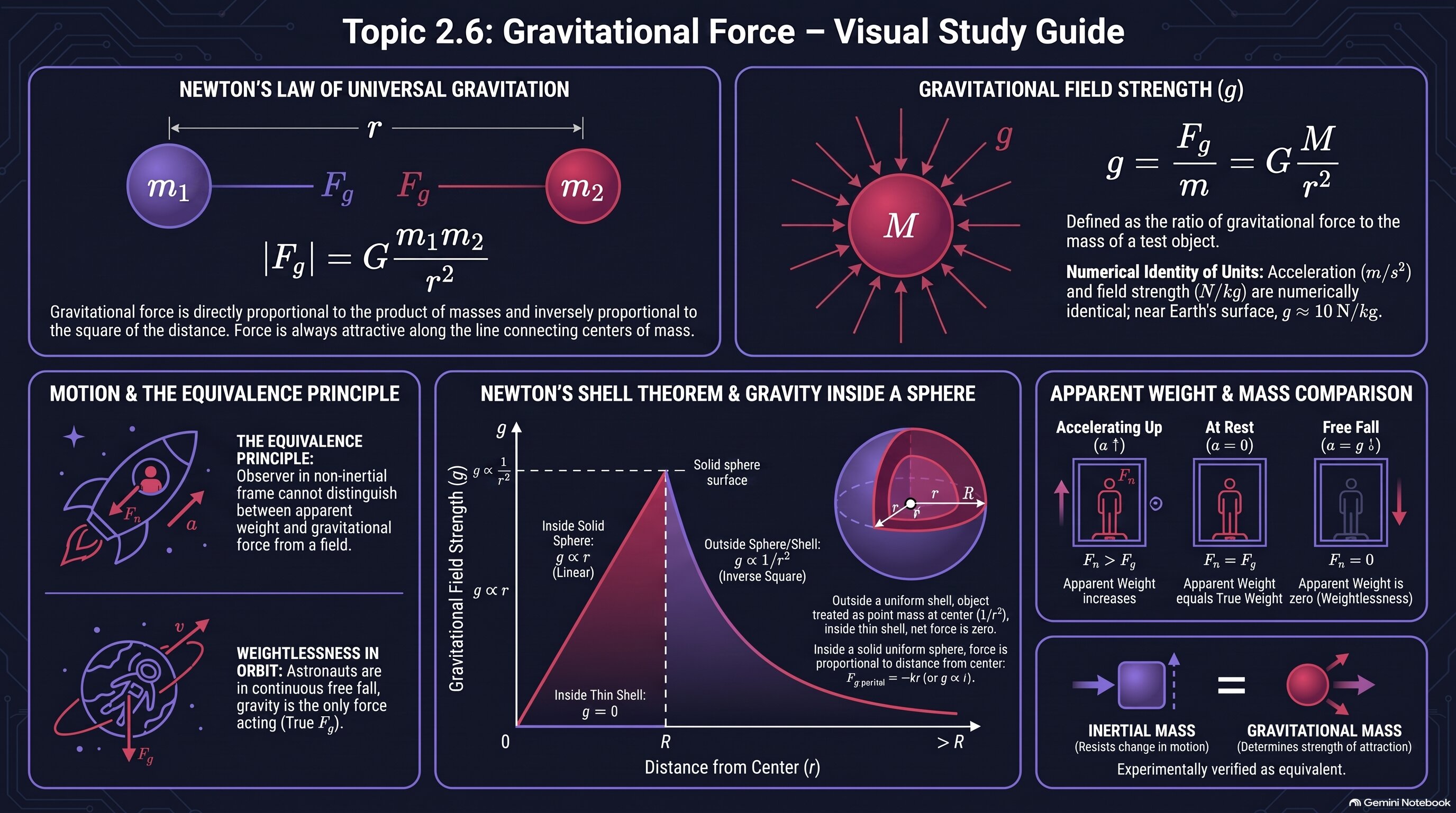
Use this as a quick reference for universal gravitation, fields, apparent weight, and Newton's shell theorem.
🧭 Plot Summary
This is the biggest lesson in Unit 2 — the first genuine force law you'll plug into F=ma. Newton's law of universal gravitation says every pair of masses attracts each other with a force that falls off as the square of the distance between them. From there, this lesson builds outward in every direction: gravitational fields as a way to describe gravity's effect at a point in space without naming a second object; the surprising difference between apparent weight (what a scale reads) and actual gravitational force; why astronauts in orbit are "weightless" despite gravity still very much acting on them; and Newton's shell theorem, which tells you exactly how gravity behaves both outside and — more surprisingly — inside a uniform sphere of mass.
What you'll do in this lesson
- Apply Newton's law of universal gravitation, Fg = Gm₁m₂/r², between two masses.
- Calculate and interpret gravitational field strength, g = GM/r².
- Determine when gravitational force can be approximated as constant.
- Distinguish apparent weight from true gravitational force in accelerating frames.
- Explain weightlessness and the equivalence principle.
- Distinguish inertial mass from gravitational mass.
- Apply Newton's shell theorem inside and outside uniform spherical mass distributions.
Why it matters
Gravity is the first of several specific force laws this unit introduces (springs and friction are coming next) — and it's the one that connects most directly to astronomy, orbital motion, and the "why do astronauts float" question nearly every student already has.
✅ Self-Check Before You Roll On
Check off each item as you get there. These aren't grades — they're your own signal.