Use this as a quick reference for unbalanced forces, F=ma, and solving connected pulley systems.
🧭 Plot Summary
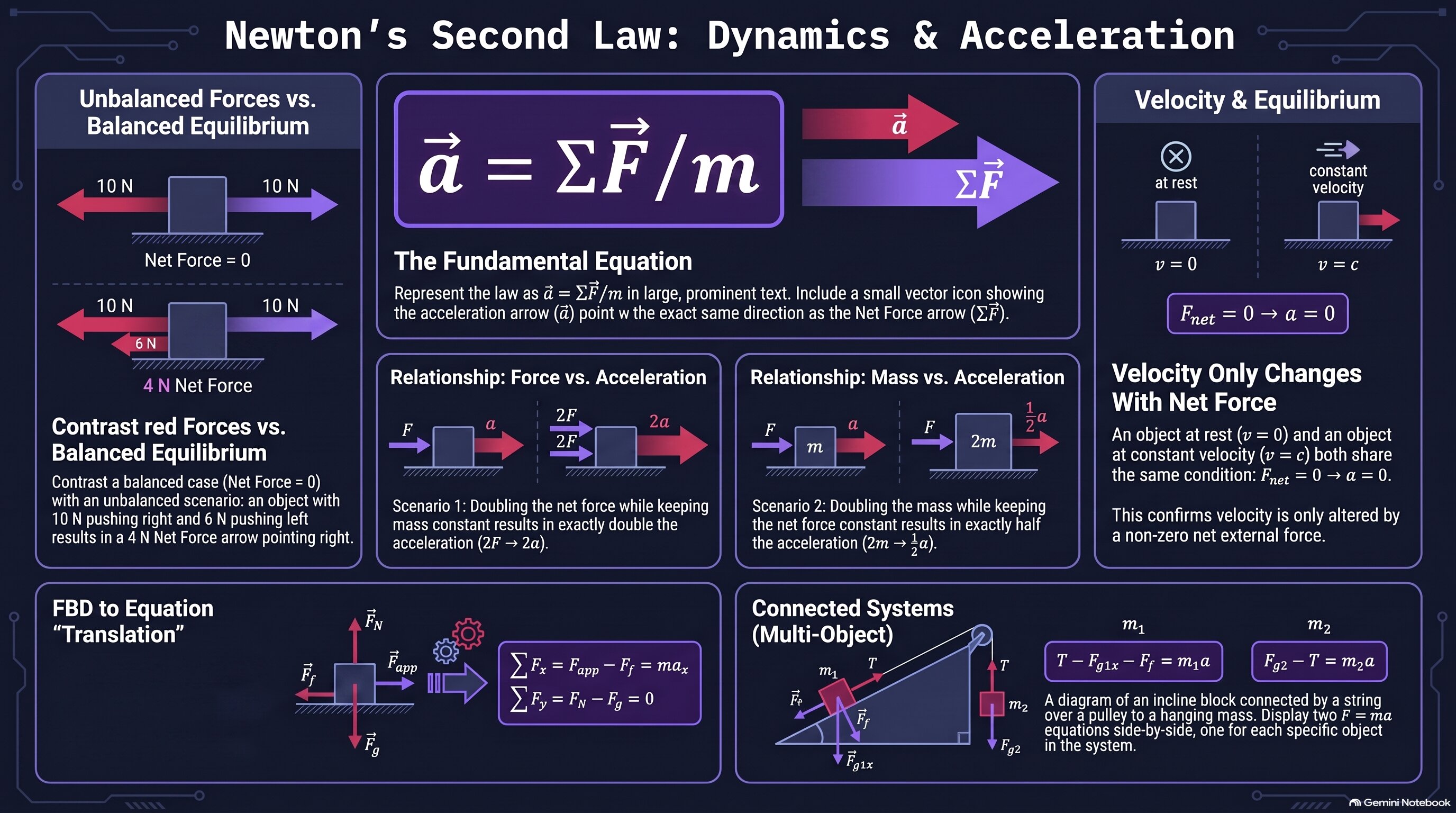
Everything you've built in Unit 2 so far — systems, free-body diagrams, third-law pairs, equilibrium — leads directly here. When the forces on a system don'tcancel, Newton's second law tells you exactly what happens next: the system's center of mass accelerates in the same direction as the net force, with a magnitude proportional to that force and inversely proportional to mass. This lesson is where free-body diagrams stop being just pictures and start becoming actual equations — including full systems of equations for objects connected by a string, like the incline-and-hanging-mass setup from this unit's header art.
What you'll do in this lesson
- Distinguish unbalanced force configurations from the equilibrium case in Lesson 2.4.
- Apply Newton's second law, a⃗ = ΣF⃗ / m, to find a system's acceleration.
- Confirm that acceleration always points in the same direction as the net force.
- Set up signed F=ma equations axis by axis, directly from a free-body diagram.
- Solve simultaneous F=ma equations for two objects connected by a string over a pulley.
- Predict how changes in force or mass scale a system's resulting acceleration.
Why it matters
Newton's second law is the single most-used equation for the rest of this course. Every remaining Unit 2 topic — gravity, friction, springs, drag — is really just a new way of computing the "F" that goes into this equation.
✅ Self-Check Before You Roll On
Check off each item as you get there. These aren't grades — they're your own signal.