Use this as a quick reference for net force, translational equilibrium, and analyzing balanced vs. unbalanced axes.
🧭 Plot Summary
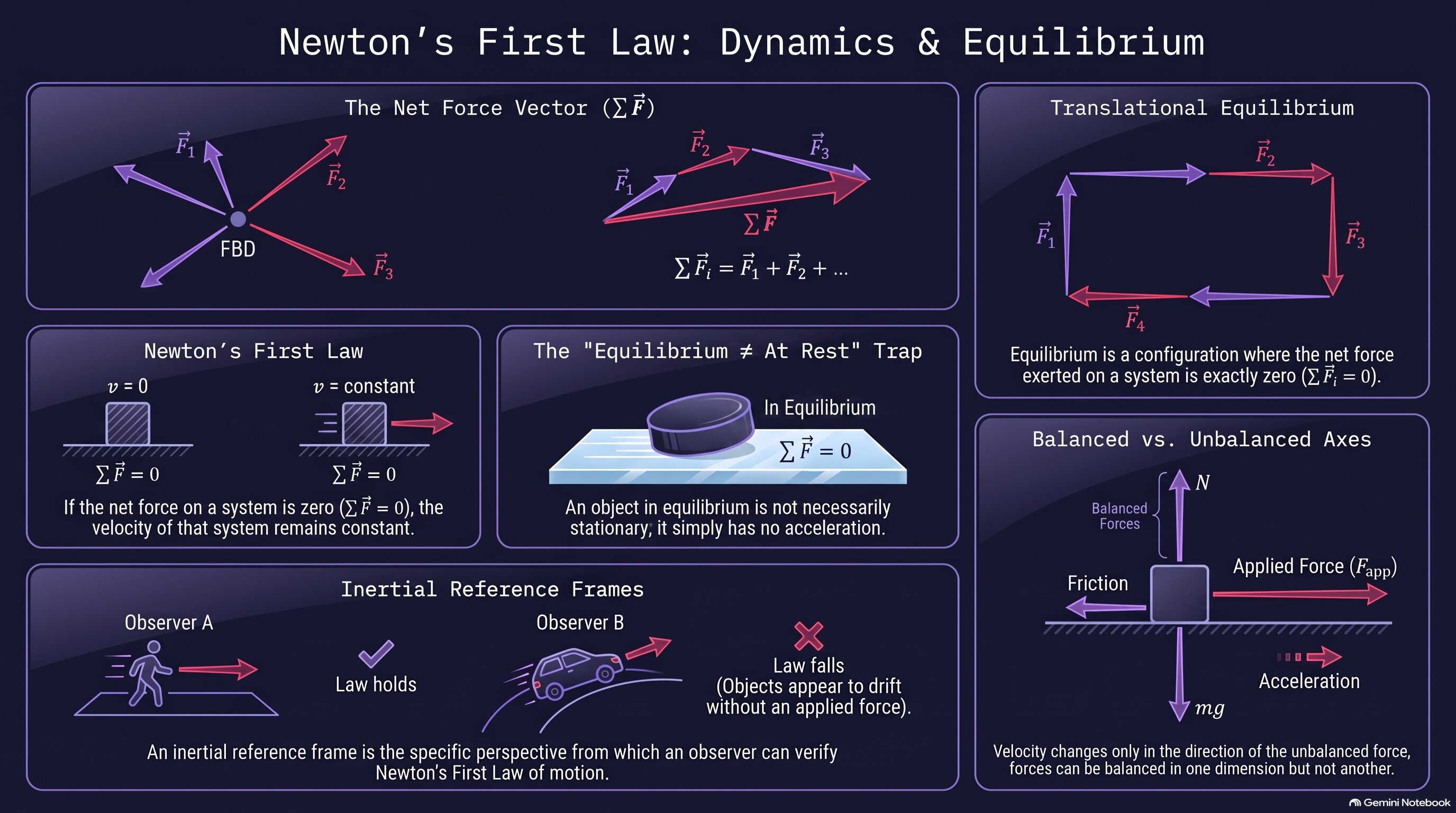
The net force on a system is just the vector sum of every force acting on it — and when that sum comes out to exactly zero, the system is in translational equilibrium. Newton's first law says that whenever a system is in equilibrium, its velocity stays constant — which includes staying at rest, but just as validly includes coasting along at a constant nonzero speed forever. The catch worth remembering: balance is checked axis by axis. A system can be perfectly balanced vertically while being wildly unbalanced horizontally, and its velocity will only change in that unbalanced direction.
What you'll do in this lesson
- Find the net force on a system by summing all individual forces as vectors.
- Recognize translational equilibrium as the condition ΣF⃗ = 0.
- State Newton's first law and apply it to systems at rest or moving at constant velocity.
- Analyze forces separately along perpendicular axes — balanced on one, unbalanced on another.
- Predict that velocity only changes in the direction of a nonzero net force.
- Connect Newton's first law back to the inertial reference frames from Lesson 1.4.
Why it matters
Newton's first law is the boundary between this lesson and the next: whenever ΣF⃗ = 0, you're done — velocity doesn't change. The moment ΣF⃗ ≠ 0, you need Newton's second law (Lesson 2.5) to find out exactly how the velocity changes.
✅ Self-Check Before You Roll On
Check off each item as you get there. These aren't grades — they're your own signal.