Use this as a quick reference for Newton's third law pairs, internal vs. external forces, and ideal string/pulley assumptions.
🧭 Plot Summary
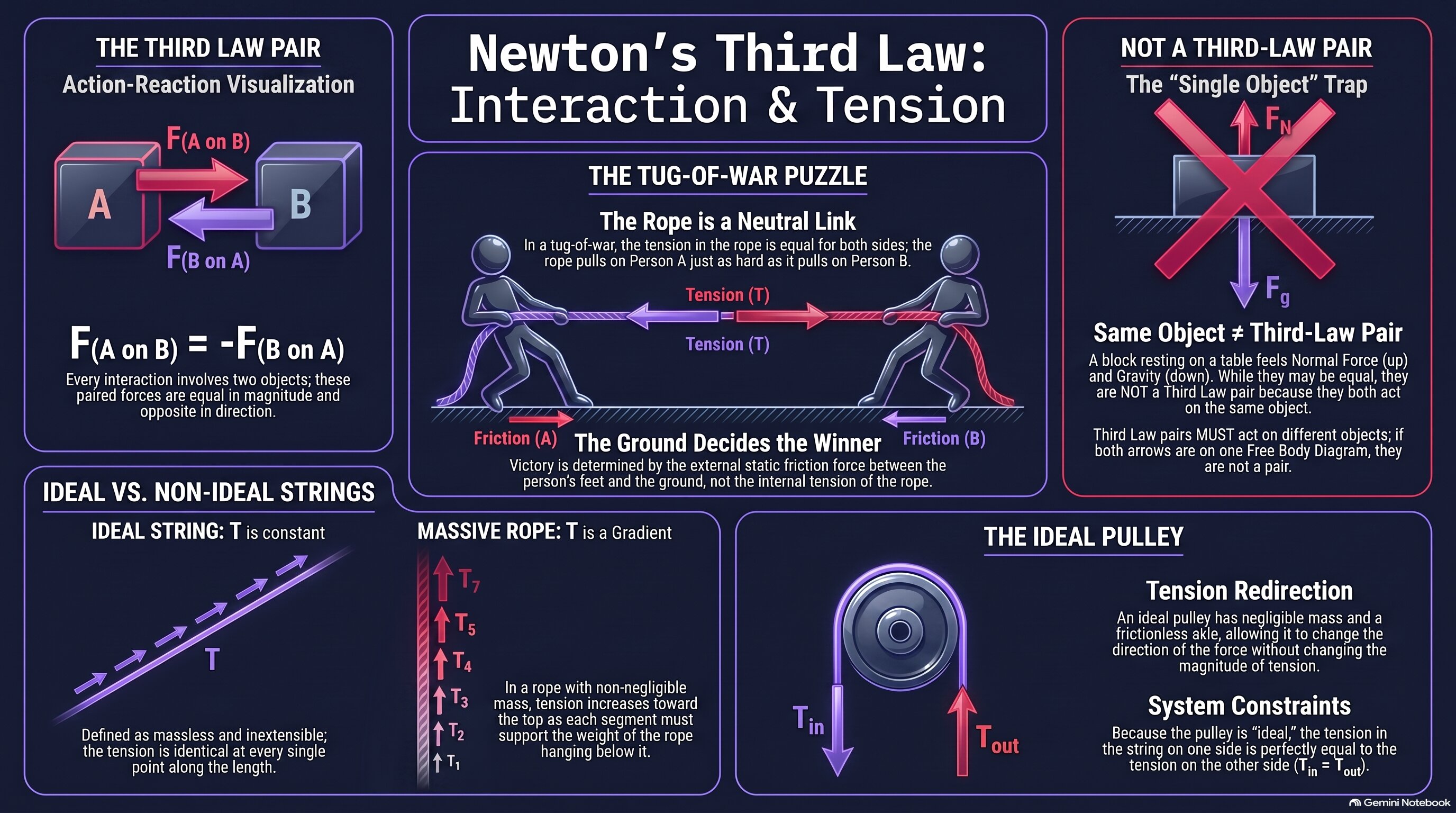
Every interaction is a two-way street. Newton's third law says that when object A exerts a force on object B, object B exerts an equal and opposite force right back on A — always on different objects, never the same one. This explains a strange fact about tug-of-war: the rope's tension is genuinely identical at both ends, and yet one side usually wins anyway. This lesson also takes a close look at tension itself — what it really is at a microscopic level, and the assumptions ("ideal" strings and pulleys) that make tension problems solvable without needing to track every infinitesimal piece of rope.
What you'll do in this lesson
- State Newton's third law and correctly identify paired forces acting on two different objects.
- Distinguish a true third-law pair from two different forces that happen to act on the same object.
- Explain why internal forces can't change a system's center-of-mass motion.
- Describe tension as the net effect of countless internal string forces responding to an external pull.
- Apply the ideal string assumption — negligible mass, uniform tension — to pulley problems.
- Recognize when a string's mass can't be ignored, and how that changes the tension along its length.
Why it matters
Mixing up a Newton's third law pair with two unrelated forces on the same object is one of the most common mistakes in all of mechanics — including on the AP exam. Getting this distinction airtight now will save you from a whole category of errors for the rest of the course.
✅ Self-Check Before You Roll On
Check off each item as you get there. These aren't grades — they're your own signal.