Use this as a quick reference for what counts as a force, free-body diagram conventions, and choosing smart coordinate axes.
🧭 Plot Summary
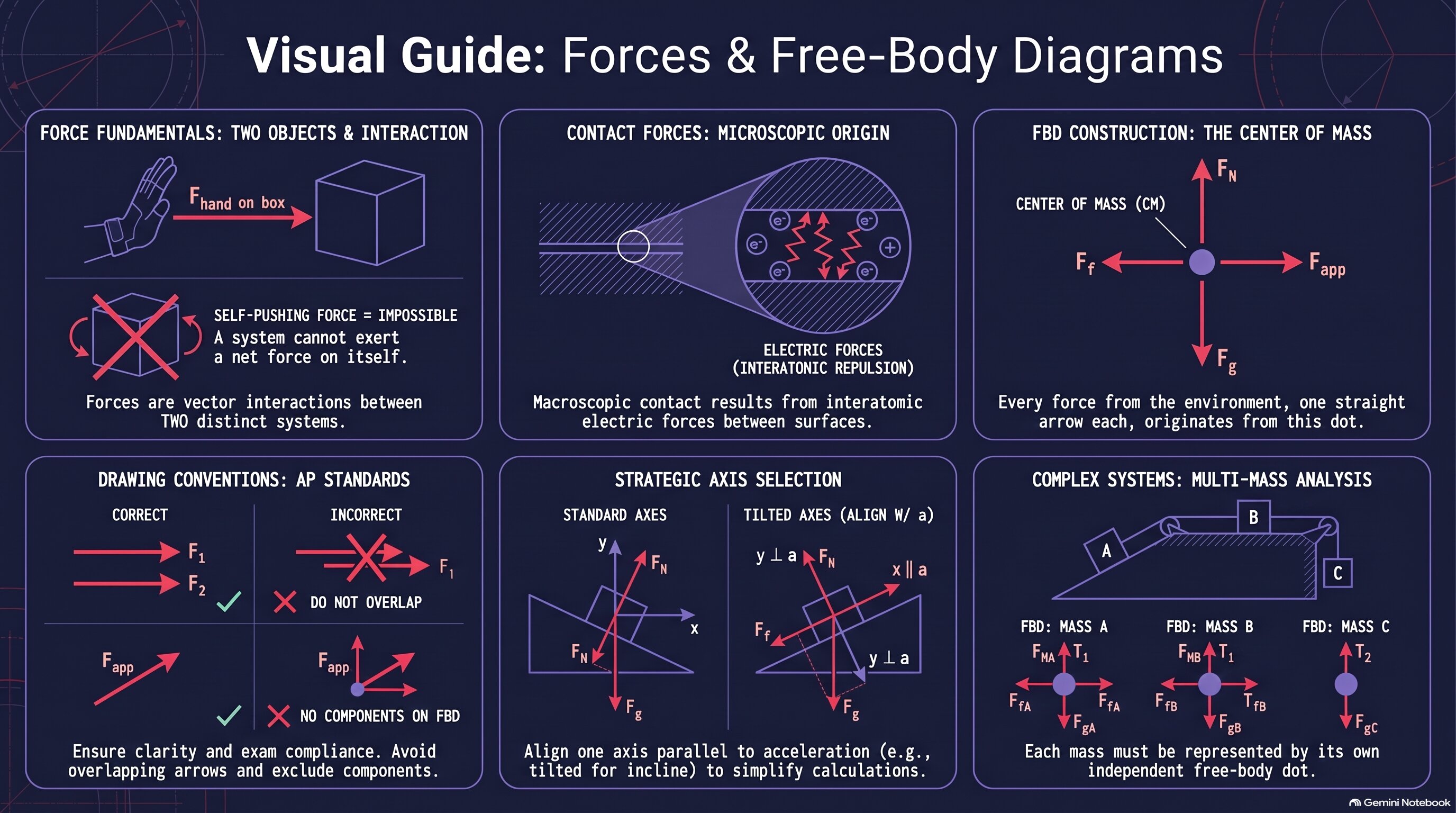
A force is never a property of a single object — it's always the signature of an interaction between two objects or systems. Nothing can push or pull on itself. This lesson introduces the tool you'll use to keep every force honest: the free-body diagram — a single dot representing an object's center of mass, with an arrow for every force the environment exerts on it. Draw it right, and the diagram practically writes the algebra for you, especially once you pick a coordinate system with an axis lined up with the direction of acceleration.
What you'll do in this lesson
- Describe every force as an interaction between two specific objects or systems.
- Distinguish contact forces as macroscopic effects of interatomic electric forces.
- Draw a complete free-body diagram showing every environmental force on a system.
- Represent forces as arrows originating from a system's center of mass.
- Choose a tilted coordinate system — like axes aligned to an incline — to simplify a diagram.
- Follow AP's drawing conventions for free-body diagrams exactly.
Why it matters
Every remaining lesson in this unit — Newton's third law, first law, second law, gravity, friction — gets solved by drawing a correct free-body diagram first. This is the skill everything else in Unit 2 depends on.
✅ Self-Check Before You Roll On
Check off each item as you get there. These aren't grades — they're your own signal.