Use this as a quick reference for centripetal acceleration, its sources, and circular orbits.
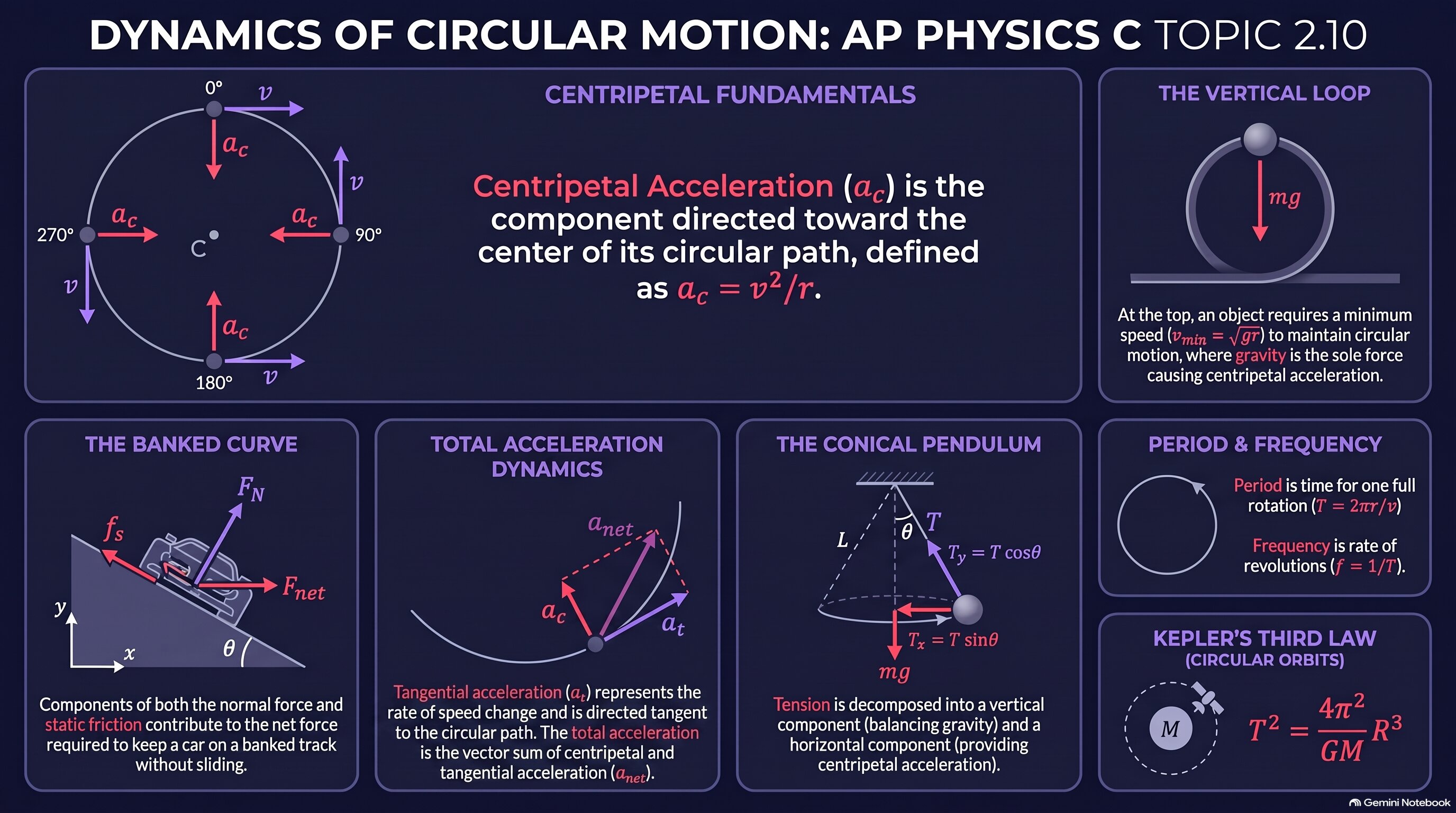
🧭 Plot Summary
This lesson closes out Unit 2 by pointing everything you've learned toward a single destination: the center of a circle. Centripetal acceleration — the piece of acceleration that constantly redirects an object's velocity without changing its speed — always points there, and it can be produced by gravity alone (a satellite, or the exact minimum speed at the top of a loop), by a combination of normal force and friction (a car on a banked curve), or by the pull of a string (a conical pendulum). When speed is also changing, a second piece — tangential acceleration — joins in, and the two combine into the object's true net acceleration. This lesson closes with Kepler's third law, which ties a satellite's orbital period directly to the mass of whatever it's orbiting.
What you'll do in this lesson
- Calculate centripetal acceleration and identify the forces or force components that produce it.
- Analyze vertical loops, banked curves, and conical pendulums as centripetal force scenarios.
- Distinguish tangential acceleration from centripetal acceleration and combine them into net acceleration.
- Relate period, frequency, speed, and radius for uniform circular motion.
- Apply Kepler's third law to circular satellite orbits.
Why it matters
Circular motion is where gravity (2.6), friction (2.7), and Newton's second law (2.5) all get reused at once — it's the natural capstone for everything Unit 2 has built, and it sets up rotational dynamics later in the course.
✅ Self-Check Before You Roll On
Check off each item as you get there. These aren't grades — they're your own signal.