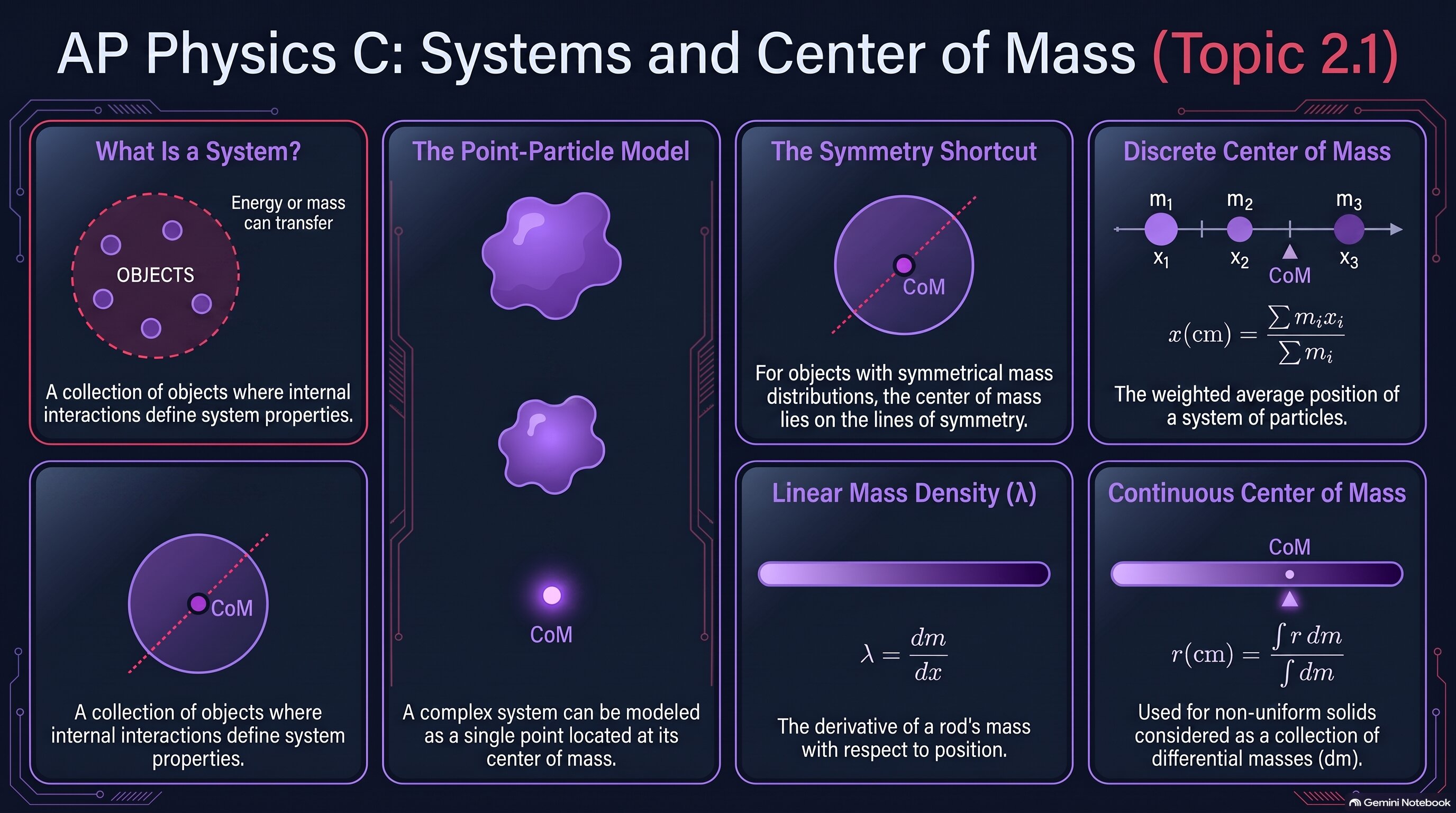
Use this as a quick reference for systems thinking, symmetry, and the discrete and continuous center-of-mass formulas.
🧭 Plot Summary
Welcome to Unit 2 — where kinematics meets the forces that actually cause it. Before forces enter the picture, though, this lesson asks a quieter question: what exactly is the "object" that a force acts on? A system can be one particle, a block, a whole rocket, or a pile of unrelated junk — the label is a choice you make, and its properties come from how its parts interact. Every system, no matter how messy internally, has a single point that summarizes its overall motion: its center of mass. For a handful of point masses, finding it is a weighted average. For a real, continuous object — a rod with density that changes along its length — finding it means setting up an integral.
What you'll do in this lesson
- Describe how a system's behavior emerges from interactions between its parts and with its environment.
- Decide when a system can be simplified to a single object versus needing part-by-part analysis.
- Locate a symmetric object's center of mass along its lines of symmetry.
- Calculate center of mass for discrete point-mass systems using a weighted sum.
- Set up and evaluate an integral to find center of mass for continuous, nonuniform objects.
- Find linear mass density as a derivative, and total mass by integrating a density function.
Why it matters
Every force law for the rest of this unit — Newton's second law included — is written in terms of a system's center of mass, not some arbitrary point on it. This lesson is what makes "treat the block as a point" a mathematically justified move instead of just a convenient simplification.
✅ Self-Check Before You Roll On
Check off each item as you get there. These aren't grades — they're your own signal.