Use this as a quick reference for separating variables, solving the resistive-force equation, and finding terminal velocity.
🧭 Plot Summary
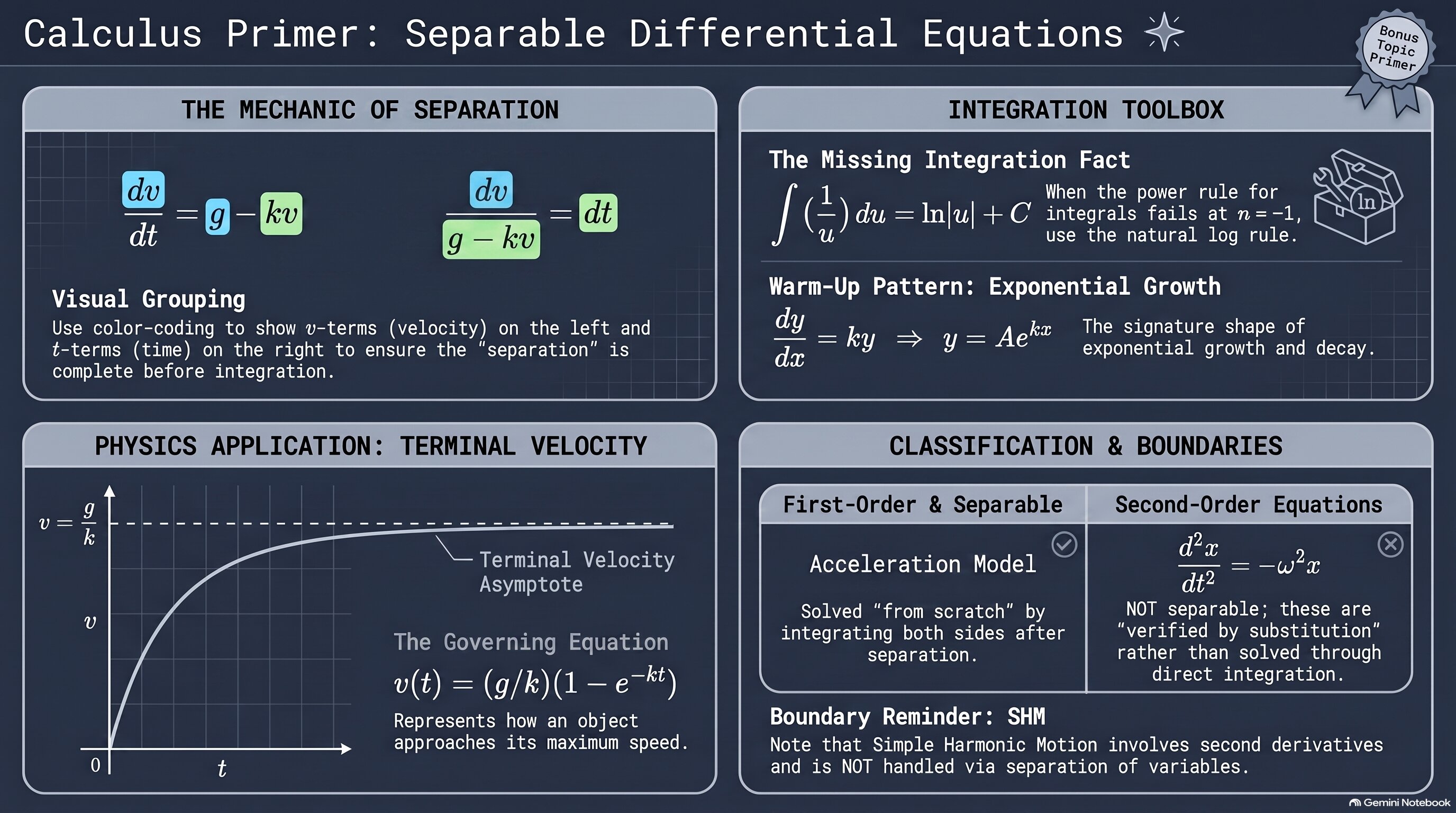
Every equation solved so far in Unit 0 had the variable you were solving for sitting neatly by itself on one side. Some equations aren't so polite — they mix a variable and its own derivative together in the same expression, like dv/dt = g − kv. Equations like this are called differential equations, and one whole family of them — the separable ones — can be pulled apart with nothing more than algebra and the integration you already know.
What you'll do in this lesson
- Learn what makes a differential equation "separable," and the general technique for solving one.
- Pick up one more needed fact: ∫(1/u) du = ln|u| + C.
- Solve a simple exponential differential equation by separating variables.
- Set up and solve the resistive-force differential equation to find v(t) and terminal velocity.
- See why the SHM differential equation needs a different approach entirely.
Why it matters
Unit 2.9 (Resistive Forces) hands you exactly this kind of equation and expects you to find v(t) and terminal velocity from it. This lesson is the one piece of calculus those units assume you already have.
✅ Self-Check Before You Roll On
Check off each item as you get there. These aren't grades — they're your own signal.