Use this as a quick reference for spotting composite functions, applying the chain rule, and differentiating sinusoids.
🧭 Plot Summary
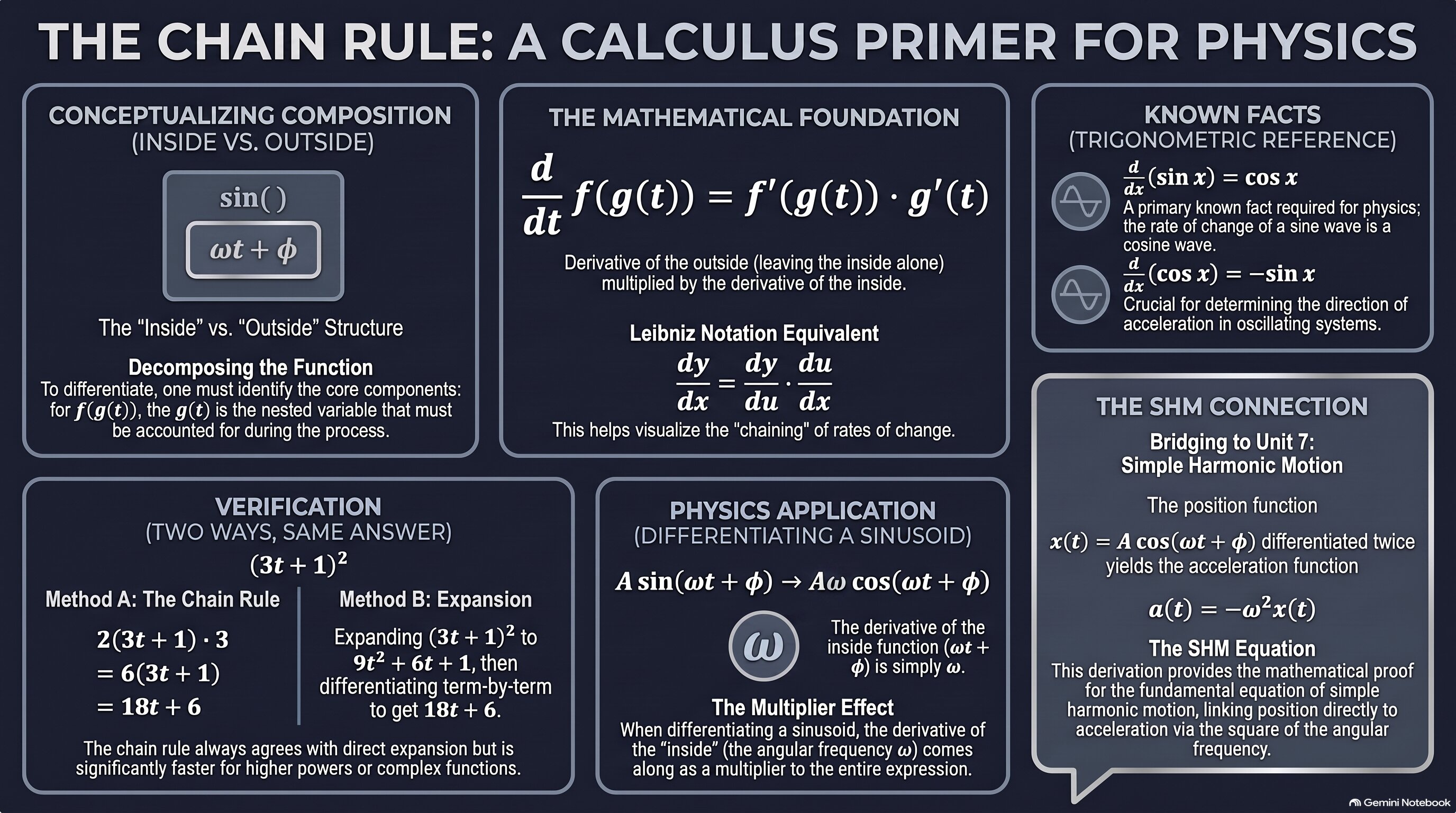
So far, every function you've differentiated has had a single variable sitting by itself — x², x⁻², √x. But plenty of functions you'll meet this year are one function tucked inside another, like sin(ωt + φ), where "ωt + φ" is buried inside "sin( )." The power rule alone can't touch that. The chain ruleis what lets you peel back a composite function one layer at a time: differentiate the outside layer, then multiply by the derivative of what's tucked inside it.
What you'll do in this lesson
- Learn to spot the "inside" and "outside" of a composite function.
- Apply the chain rule: differentiate the outside, leave the inside alone, then multiply by the inside's derivative.
- Check a chain-rule result against direct expansion to build trust in the rule.
- Pick up the derivatives of sine and cosine, and apply the chain rule to a sinusoidal function.
- Differentiate a cosine function twice to confirm it satisfies the SHM differential equation.
Why it matters
Oscillations in Unit 7 are described almost entirely with functions like A cos(ωt + φ). Without the chain rule, there's no way to find that function's velocity or acceleration — and no way to confirm it's even a valid solution to the equation of motion in the first place.
✅ Self-Check Before You Roll On
Check off each item as you get there. These aren't grades — they're your own signal.